Free shipping on orders over $60$5 flat rate under $604 items: 10% off · 8 items: 20% off
You save $47.97
Free shipping over $60 · 30-day returns · Dispatched in 1–2 business days
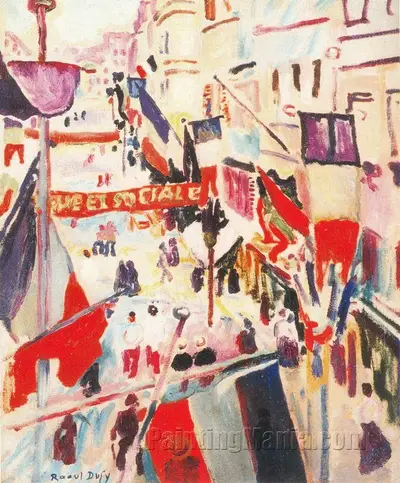
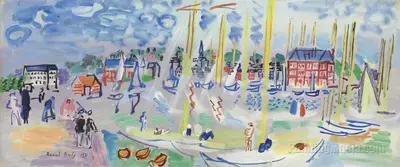
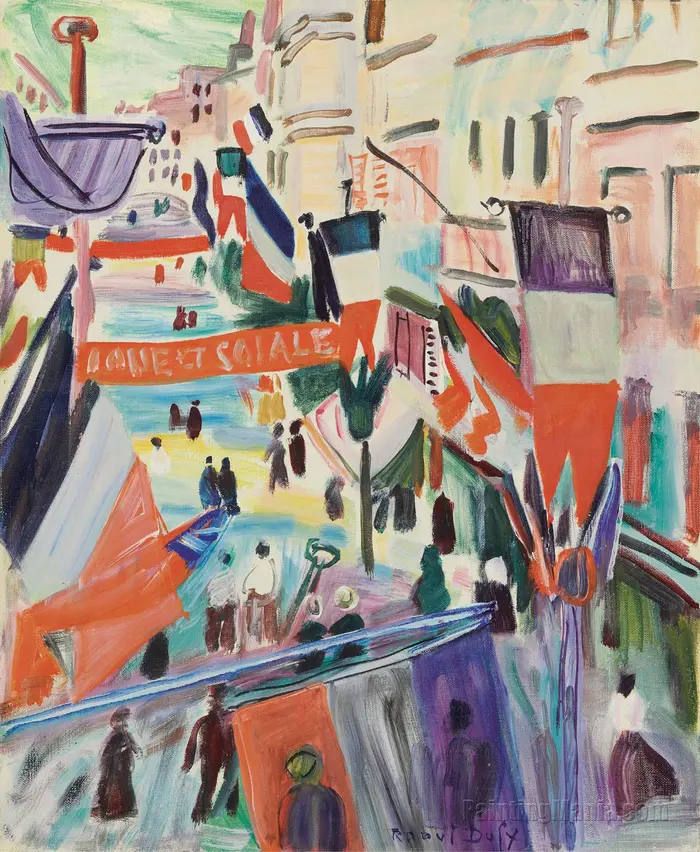
Looking for fine art oil painting with real brushwork? 14 July in Le Havre is reproduced by hand in oils on artist-grade canvas after Raoul Dufy. The result is a piece of fauvist oil painting wall decor that anchors an entryway and rewards a closer look.
14 Juillet au Havre, 1950
Oil on canvas
"What Dufy painted no other artist could have rendered, because no other possessed his gift for receiving and reflecting sensations of pleasure, light, and joy… His fine talent as a painter, his masterly use of smooth, brilliant, shining paint, so light and transparent, shows how perfectly his technique suited his artistic feeling." - M. Brion, Raoul Dufy: Paintings and Watercolours, London, 1958, p. 6
Raoul Dufy spent much of his childhood and youth in the bustling port-city of Le Havre in Northern France, and the town came to play an instrumental role in the development of his early Fauve paintings. These pictures marked the artist’s first daring explorations in colour inspired by the art of Henri Matisse and André Derain who had begun the Fauve movement, named as such by the critic Louis Vauxcelles who saw their work in the Salon d’Automne exhibition in Paris in 1905. Featuring strong, bold, primary colours, these brightly coloured paintings explore the full vibrancy of colour and gesture. Dufy’s patriotic Bastille Day subject lends itself perfectly to this purpose and represents one of the most important Fauve motifs for the artist, shown in museums worldwide who each hold examples, including the Museum of Modern Art, New York, the Centre Georges Pompidou, Paris and the National Gallery of Art, Washington D.C.
In the summer of 1906, Dufy had been joined in Le Havre by his friend and fellow artist, Albert Marquet. The pair celebrated the French national holiday, Bastille Day, on the 14th of July which inspired Dufy to commence an important series of paintings in which he attempted to capture a sense of the joyous atmosphere and overwhelming excitement that filled the boulevards of Le Havre during the festivities. This series of paintings defines the very essence of Fauve painting and were painted at the very height of the artist's affiliation with this radical movement. Dora Perez-Tibi has written, "[Dufy] kept creating new variations on the subject like a composer constantly repeating his melodic phrase. This procedure reveals his full control of his means: he gives free rein to his lyricism in order to transpose reality to the advantage of his poetic and visual imagination."
In 14 juillet au Havre, Dufy focused on the view from the window of his hotel room, to the street below, the Rue Pavoisée which appears festooned in flags, the distinctive colour combination of the French tricolour hanging from every available pole on the thoroughfare. These, along with the celebratory banners, enliven the street scenes into a festive spectacle, as Dufy imbues each flag with its own distinct character. In the foreground of the composition, two of the revellers are glimpsed through the semi-transparent fabric of the foremost flag, which bathes them in its bright, vibrant colours and roots them in the joyous sense of celebration that Dufy experienced on the streets of Le Havre that day.
Towards the end of his life, the artist returned to some of the major themes and images that had occupied him in these important early canvases, revisiting compositions such as 14 juillet au Havre with a renewed sense of fervour and energy. Dufy may have chosen to revisit the scene for the present canvas following a brief trip to Le Havre in April 1950. He had returned to the port town to attend a memorial service for his fellow artist, the late Emile Othon Friesz, and the experience may have rekindled his memories of the ground-breaking summer which had dramatically shaped his art. Like a memory that becomes more vivid than the experience of the original event, the artist's new version of 14 juillet au Havre boasts a bright, light-filled aspect that surpasses the original and represents a patriotic and personal hommage to this important theme within the artist’s significant career.
As entryway wall decor, the piece pairs naturally with other fauvist wall art and with warm neutrals, timber, and soft natural light.
Materials matter for fauvist wall decor. That is why this piece is built on artist-grade canvas with lightfast oil colors, applied by hand rather than output from a printer, and sealed for long-term display.
Style it over a fireplace, behind a reading chair, or along a staircase. Wherever it goes, this fauvist oil painting wall decor adds the layered color that only a hand painted canvas provides.
Whether the search term is fine art oil painting, entryway wall decor, or fauvist oil painting wall decor, this hand painted canvas delivers the same thing: a real painted surface, made to your chosen dimensions.
| Size | Price |
|---|---|
| 20 X 24 in | $47.98 |
| 24 X 36 in | $77.98 |
| 30 X 40 in | $104.48 |
| 36 X 48 in | $149.48 |
| 48 X 72 in | $291.98 |
The sizes shown are the reproduction canvas sizes we paint to order. The dimensions given in a work's description refer to the original artwork and will differ from the sizes offered here. Not sure? Read the size guide or e-mail us.
Free on orders over $60; a flat $5 below that. Dispatched in 1–2 business days; 30 days to send it back. Full policy.
Every canvas is painted by hand in oils on artist-grade stretched canvas, with an extra blank border left for framing. How to care for your painting.
Measurements are on the size guide, or e-mail [email protected] and we reply within one business day.