Free shipping on orders over $60$5 flat rate under $604 items: 10% off · 8 items: 20% off
You save $109.97
Free shipping over $60 · 30-day returns · Dispatched in 1–2 business days
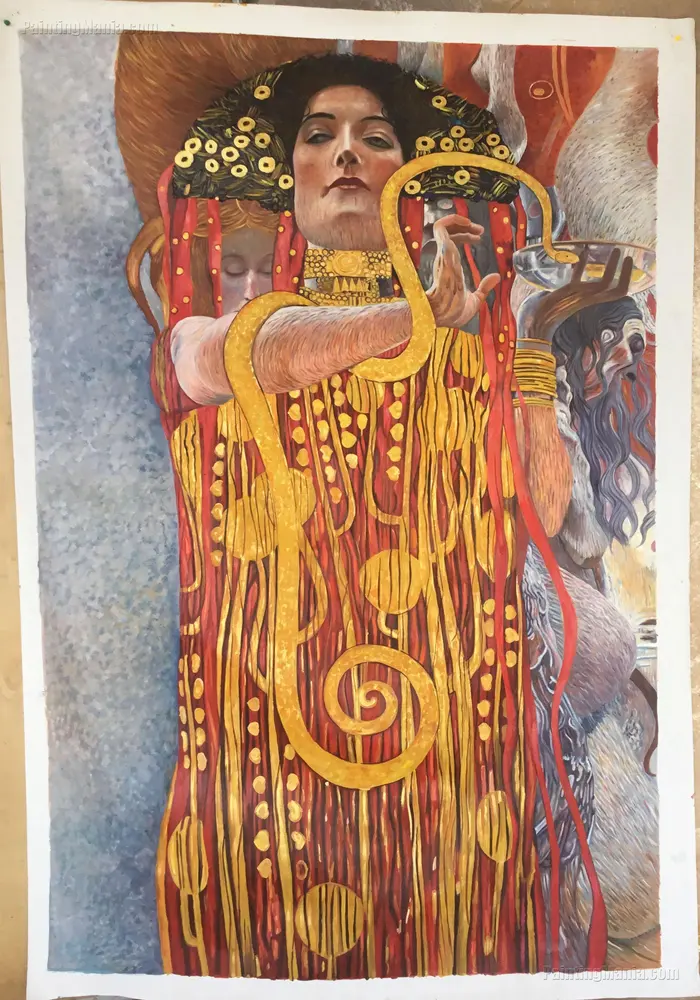
Looking for fine art oil painting with real brushwork? Hygeia Detail from "Medicine" is reproduced by hand in oils on artist-grade canvas after Gustav Klimt. The result is a piece of art nouveau oil painting wall decor that anchors a home office and rewards a closer look.
1907
Oil on canvas
430 x 300 cm
Destroyed by fire at Immendorf Palace, 1945.
Medicine was the second of University of Vienna Ceiling Paintings, presented in March 1901 at the tenth Secession Exhibition. It featured a column of nude figures on the right hand side of the painting, representing the river of life. Beside it was a young nude female who floated in space, with a newborn infant at her feet, representing life. A skeleton represented death in the river of life. The only link between the floating woman and the river of bodies is two arms, the woman's and a man's as seen from behind. Figure of Hygeia, the mythological daughter of the god of medicine is shown at the bottom of the painting. Hygieia stood with the Aesculapian snake around her arm and the cup of Lethe in her hand, turning her back to mankind. Klimt conveyed an ambiguous unity of life and death, with nothing to celebrate the role of medicine or the science of healing.
Klimt was loyal to traditional depictions of the goddess, providing her with a snake and the cup of Lethe. However, above Hygeia, Klimt painted a large column of light, and placed on either side several nude figures and, most notably, a skeleton to symbolize Death. For this Klimt received much criticism from physicians and university officials who were offended by what they saw as his lurid, almost pornographic depiction, of the human form, and for suggesting that the healing arts were unable to prevent death. Klimt's University paintings, of which Medicine was a part, were some of his first works to explore the female form in vivid detail.
In 1911 Medicine eventually came into the possession of a Jewish family, and in 1938 the painting was seized by Germany. In 1943, after a final exhibition, they were moved to Schloss Immendorf, a castle in Lower Austria, for protection. In May 1945 the paintings were destroyed as retreating German SS forces set fire to the castle to prevent it falling into enemy hands. All that remains now are preparatory sketches and a few photographs. Only one photograph remains of the complete painting of Medicine, taken just before it was destroyed.
Every hand painted oil painting in this fine art series is finished on artist-grade canvas and checked against the original before it leaves the studio.
We use a 100% hand-painted process: stretched artist-grade canvas, layered oil pigment, and a final protective varnish. There are no inkjet prints or mechanical reproductions in this collection — just a painted fine art artwork made to order.
Build a home office gallery wall around this fine art oil painting, or let it stand alone as a single statement. The hand painted canvas finish keeps the fine art composition looking intentional in both classic and contemporary rooms.
Browse our Gustav Klimt Paintings selection for related fine art canvases, or commission this fine art image in a custom size. Every order is a hand painted oil painting, never a printed poster.
| Size | Price |
|---|---|
| 20 X 24 in | $109.98 |
| 24 X 36 in | $167.98 |
| 30 X 40 in | $216.48 |
| 36 X 48 in | $292.98 |
| 48 X 72 in | $554.98 |
The sizes shown are the reproduction canvas sizes we paint to order. The dimensions given in a work's description refer to the original artwork and will differ from the sizes offered here. Not sure? Read the size guide or e-mail us.
Free on orders over $60; a flat $5 below that. Dispatched in 1–2 business days; 30 days to send it back. Full policy.
Every canvas is painted by hand in oils on artist-grade stretched canvas, with an extra blank border left for framing. How to care for your painting.
Measurements are on the size guide, or e-mail [email protected] and we reply within one business day.