Free shipping on orders over $60$5 flat rate under $604 items: 10% off · 8 items: 20% off
You save $77.97
Free shipping over $60 · 30-day returns · Dispatched in 1–2 business days
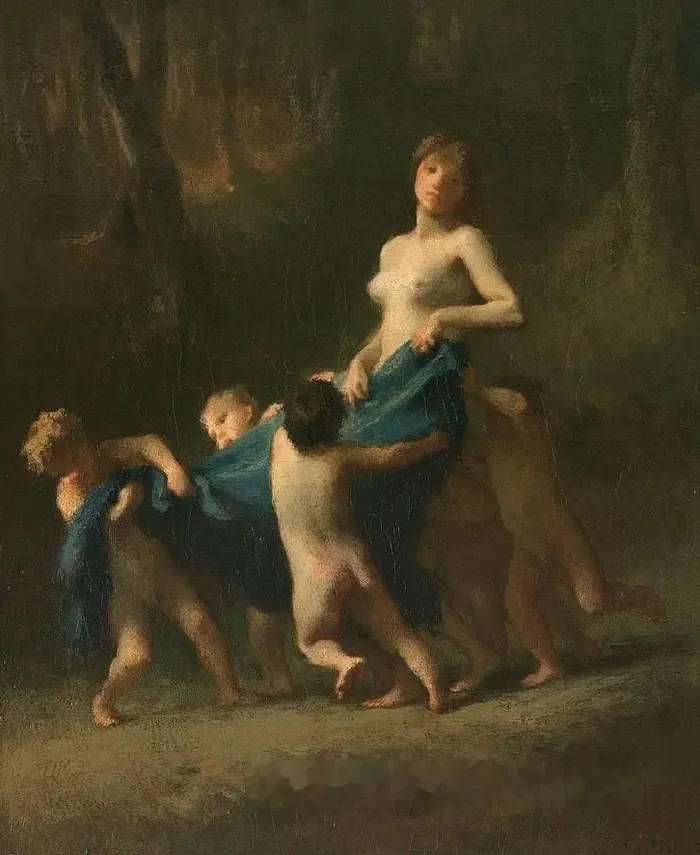
Upgrade your walls with L'Amour Vainqueur - Jean-Francois Millet - Romantic Fine Art Reproduction. Every fine art reproduction is painted entirely by hand, so the surface carries the depth and variation of an original oil painting rather than the flatness of a digital canvas print.
1851
Oil on canvas
Musée Thomas Henry, Cherbourg.
The beautiful young woman in L'Amour Vainqueur, who hesitates so poignantly as a troop of charming putti pull and push and prod her toward a lovers' rendezvous, is the last of the alluring nudes that were the great triumph of Jean-Francois Millet's first decade as a mature artist. Millet worked on L'Amour Vainqueur between 1847 and 1851, during the same period in which he completed and exhibited The Sower (which won him renown at the Salon of 1850) and began his first scenes of Barbizon woodgatherers and harvesters. The hallmarks of Millet's peasant realism – the carefully observant draughtsmanship, the eye for a telling gestural detail, and the power to focus a complex array of emotions in the posture of a single figure -- are all foretold in this last of his romantic idylls.
Millet's nudes are less well known today than his scenes of country laborers -- many are undoubtedly lost and the whereabouts of L'Amour Vainqueur had gone unrecorded for nearly a century -- but they are the crucible in which the realism for which the artist is so celebrated was first formed. When Millet left the école des Beaux-Arts in 1839, he tried assiduously to build a career on portrait painting and the history pictures of Salon competition. But those works would not support his growing household and he turned increasingly to small genre scenes depicting popular folk tales or an idealized rural life. Initially Millet drew nudes only to amuse friends or to explore poses for a large composition; but around 1846 he turned seriously to the study of the female nude, probably under the encouragement of his new friends Diaz and Troyon, who both had significant success with nudes painted in a deliberately eighteenth-century manner. Where those artists favored lush goddesses or doll-like female types devoid of personality, Millet preferred real females, and he looked to the example of Pierre Prud'hon rather than to Boucher or to Fragonard. L'Amour Vainqueur may specifically have been inspired by Prud'hon's L'Amour seduisant L'Innocence (private collection, Paris) in which a young maiden listens avidly to the attractive young god by her side as a single putto pulls her along by her skirt. Prudhon's painting of 1809 was exhibited in Paris in 1846 in a much heralded exhibition on the Boulevard Bonne-Nouvelle but would also have been available to Millet in a print.
Little is known of the clientele for Millet's nudes. Generally, he sold his genre scenes for very modest prices to small Paris dealers such as Desforges or Beugniet. L'Amour Vainqueur, however, was sold on Millet's behalf by Alfred Sensier, the artist's friend, biographer and sometime-agent, directly to an unidentified collector. At a later date Sensier re-purchased the painting for his own extraordinary collection of Millet's work. L'Amour Vainqueur first came to public notice when it was published in an etching by Le Rat under its alternative title Femme entrainé par les amours by the Durand-Ruel Gallery shortly after the dealer purchased much of Sensier's collection in 1873. James Staats Forbes, a Scottish railroad baron who built a large collection of Barbizon and Dutch paintings during the last decades of the 19th century, lent the painting generously to exhibitions in Edinburgh and London, securely establishing its fame.
The only known preparatory work for L'Amour Vainqueur is Millet's life study for the young woman's head and torso (Cabinet des desins, Musée du Louvre), a drawing in crayon noir which has become Millet's most widely reproduced image of a nude and has served as the only accessible evidence of the painting since the picture left the Forbes collection around 1907. A smaller Millet painting of a young woman clutching her draperies while assailed by cupids (often confused with L'Amour Vainqueur) was formerly in the collection of Sir Kenneth Clark and now belongs to the Musée Thomas Henry, Cherbourg. Alexandra R. Murphy
Collectors often choose this fine art image when searching for fine art oil painting that feels substantial rather than decorative or disposable.
Trained artists work in stages — underpainting, mid-tones, highlights, and detail — using traditional oils on canvas. Because nothing is printed, every hand painted oil painting has its own subtle texture and depth.
For living room wall decor that does not feel generic, a painted fine art canvas is hard to beat. It is a popular fine art oil painting pick for new homeowners and a durable alternative to seasonal poster art.
| Size | Price |
|---|---|
| 20 X 24 in | $77.98 |
| 24 X 36 in | $120.48 |
| 30 X 40 in | $166.48 |
| 36 X 48 in | $221.48 |
| 48 X 72 in | $430.48 |
The sizes shown are the reproduction canvas sizes we paint to order. The dimensions given in a work's description refer to the original artwork and will differ from the sizes offered here. Not sure? Read the size guide or e-mail us.
Free on orders over $60; a flat $5 below that. Dispatched in 1–2 business days; 30 days to send it back. Full policy.
Every canvas is painted by hand in oils on artist-grade stretched canvas, with an extra blank border left for framing. How to care for your painting.
Measurements are on the size guide, or e-mail [email protected] and we reply within one business day.