Free shipping on orders over $60$5 flat rate under $604 items: 10% off · 8 items: 20% off
You save $58.47
Free shipping over $60 · 30-day returns · Dispatched in 1–2 business days
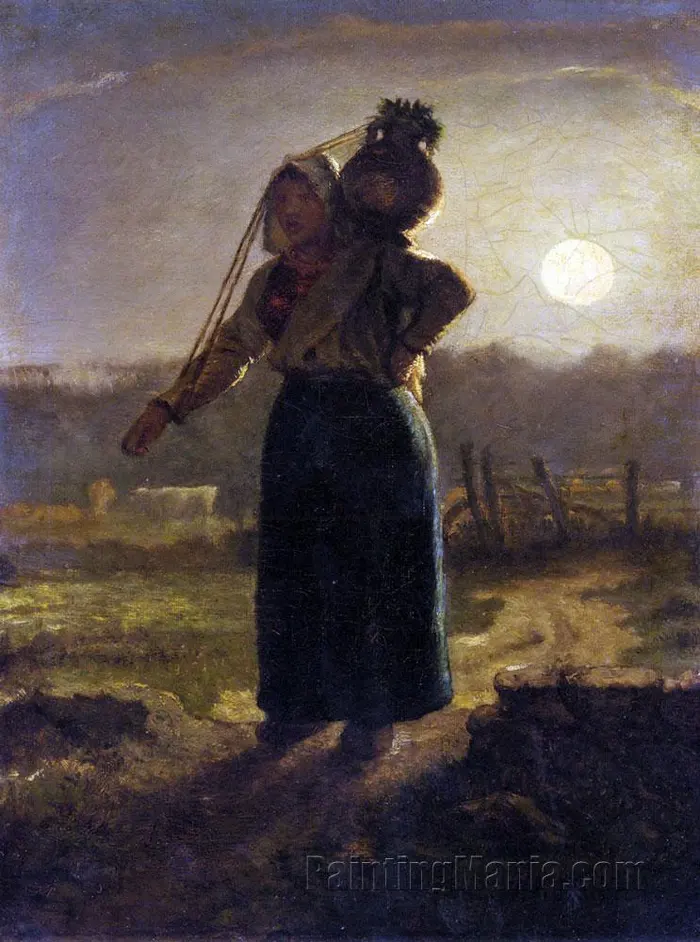
Norman Milkmaid - Jean-Francois Millet - Oil Painting is part of our hand painted oil painting collection from the Jean-Francois Millet Paintings selection. Each canvas is worked by a trained artist, then inspected before dispatch — a practical route to owning vintage wall decor at a fraction of gallery pricing.
1853-54
Oil on canvas
Private collection.
Recently rediscovered, Norman Milkmaid is an important example of Jean-Francois Millet's determined effort to shape a new, realistic imagery of rural laborers for Nineteenth-Century France and a reminder that Millet's deep affection for his native Normandy remained central to his work long after he settled in Barbizon. Painted around 1853-54, Norman Milkmaid is one of Millet's first finished paintings of a theme that he treated numerous times.
Lit from behind by an early Autumn moon, Millet's young peasant girl is returning from milking cows in a distant pasture. Her white every-day coiffe identifies her as a woman of Normandy, Millet's homeland (and a region well-known for its milk and butter). Her shiny copper canne was used not only to carry milk in from outlying fields twice a day but also to keep it cool until it could be turned to cheese or butter. The grasses that close the top of the jug prevent milk from sloshing out and flies from getting in and reflect a custom particular to her region. With the well-worn path picked out by the moonlight and the crumbling wall at which the milkmaid pauses, Millet managed to convey not only the long hours she kept and the isolation of her work, but also the timeless character of a task and a terrain unchanged for centuries.
Tending cows was one of the few country activities that had made its way into both high art and popular illustration before Millet's day, but earlier artists usually presented milkmaids as preening ninnies flirting with city boys or as hapless examples for adages such as "Don't cry over spilt milk". Early in Millet's career, he himself tucked a prancing, Boucher-esque milkmaid into the background of a signboard painted for a veterinarian; but by the early 1850s, he was searching for subjects that would allow him to present the real characteristics of hard country labor and the seriousness of the peasants who performed those tasks without complaint. Over a period of years, he sketched various milkmaid figures (he was particularly intrigued by the gesture of the outstretched arm that counterbalances the heavy canne) before arriving at the present image of a solid, hesitant countrywoman at one with her surroundings. Details like the stopper of grasses or the thick scarf cushioning the milk jug suggest that the picture probably came together for Millet during a summer stay in Normandy in 1854, his first extended return to his family homestead in nearly 10 years. A black crayon drawing (Private Collection, Japan) establishes the basic composition; for the painting, Millet enlarged the figure and placed her higher against the background. During the next 20 years, he returned to this composition in at least three further variations.
Although Norman Milkmaid was not known to Professor Robert Herbert when he wrote his seminal article on Millet's milkmaid imagery in 1980, the picture has not exactly been lost: Norman Milkmaid has been carefully passed down through several generations of a New York family for more than 90 years; and a photograph of the picture was published as early as 1915. But Norman Milkmaid is so close to another version of the subject now in the Barber Institute of Art (Birmingham, England) that references to the two paintings have been conflated into a single history since the Barber Institute picture came into the marketplace fifty years ago. That no one thought to seek out a second painting is a reflection of the fact that Millet did not copy himself often, preferring to alter and perfect well loved compositions rather than repeat them. Norman Milkmaid and its Birmingham counterpart are so close as to suggest that Millet worked on both paintings simultaneously, something he is known to have done only one other time when faced with conflicting demands for the same image (Shepherdess Knitting, one version Cincinnati Art Museum, the other Metropolitan Museum, New York).
As hallway wall art, the piece pairs naturally with other vintage wall art and with warm neutrals, timber, and soft natural light.
From primer to varnish, the work is done manually on artist-grade canvas. The absence of digital printing is deliberate: it keeps the fine art brushwork visible and gives the vintage oil painting wall decor a museum-like finish.
As hallway wall art, this canvas brings color and texture without visual noise. It scales well from a small study to a large hallway feature wall, and it is a reliable choice when shopping for fine art oil painting as a gift.
Browse our Jean-Francois Millet Paintings selection for related fine art canvases, or commission this fine art image in a custom size. Every order is a hand painted oil painting, never a printed poster.
| Size | Price |
|---|---|
| 20 X 24 in | $58.48 |
| 24 X 36 in | $91.98 |
| 30 X 40 in | $123.48 |
| 36 X 48 in | $176.98 |
| 48 X 72 in | $329.48 |
The sizes shown are the reproduction canvas sizes we paint to order. The dimensions given in a work's description refer to the original artwork and will differ from the sizes offered here. Not sure? Read the size guide or e-mail us.
Free on orders over $60; a flat $5 below that. Dispatched in 1–2 business days; 30 days to send it back. Full policy.
Every canvas is painted by hand in oils on artist-grade stretched canvas, with an extra blank border left for framing. How to care for your painting.
Measurements are on the size guide, or e-mail [email protected] and we reply within one business day.