Free shipping on orders over $60$5 flat rate under $604 items: 10% off · 8 items: 20% off
You save $87.97
Free shipping over $60 · 30-day returns · Dispatched in 1–2 business days
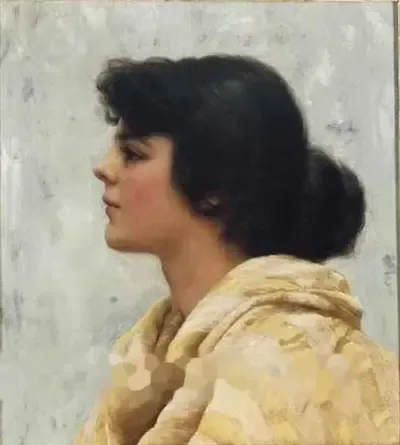
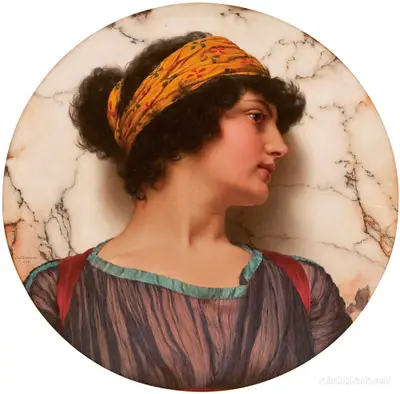
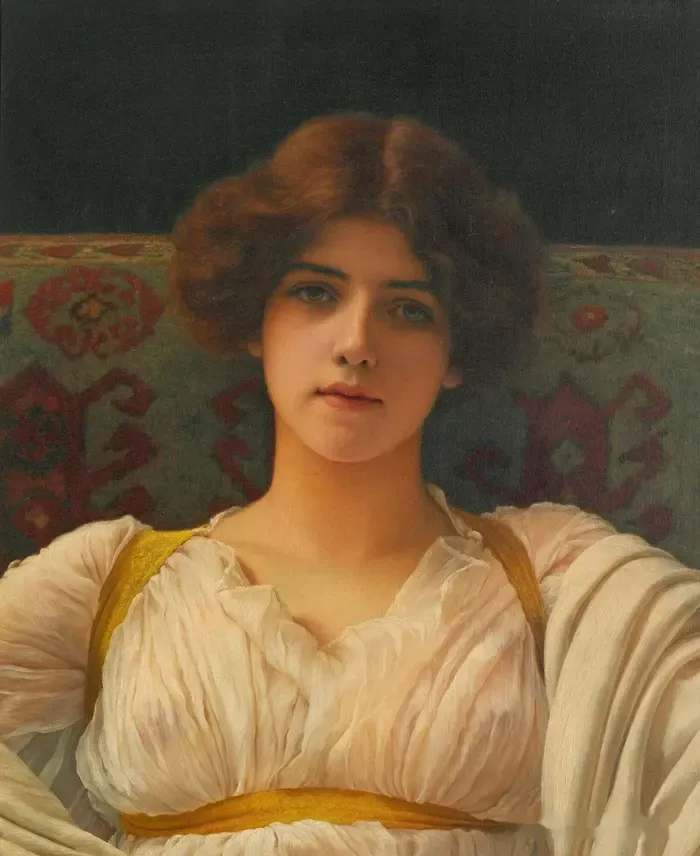
Study of a Head in Drapery, Miss Ethel Warwick by John William Godward is one of those images that never dates. Our studio recreates it as a hand painted oil painting — textured, color-rich, and ready to hang as canvas wall art in a home office, study, or reception area.
1898
Oil on canvas
This strikingly direct study of a young woman dressed in a diaphanous toga, depicts the beautiful professional artist's model Ethel Warwick (1882-1951) whose image dominated Godward's work for a brief period between 1898 and 1900. Usually preferring a darker haired and olive-skinned Mediterranean type of beauty for his classical fantasies, Miss Warwick was more Saxon in appearance. It seems that in the 1890s she replaced the famous Pettigrew sisters (Lily, Rose and Hetty) who Godward had painted in the 1880s.
Ethel Maud Warwick was born in the Northamptonshire village of Hardingstone in 1882 and appears to have begun her career as a model in the later 1890s to fund her art studies at the London Polytechnic. She lived in West Kensington amid the artistic community and soon became the favourite model for Herbert Draper who painted her as a sea-nymph in his famous painting The Lament for Icarus in 1898 (Tate). It was at this time that Godward met Ethel and painted her portrait dressed in modern style (Russell-Cotes Art Gallery and Museum, Bournemouth). Godward soon became aware that Ethel was not only willing to pose nude but was entirely without self-consciousness of being naked. The Punch cartoonist Lindley Sambourne had encouraged this by asking Ethel to pose for a series of naked photographs, used partly to aid the preparation of his cartoons. Ethel soon became invaluable to Godward as a nude model and her features can be perceived in the statuesque Venus Binding her Hair in 1897 (sold in these rooms, 23 May 2013, lot 24), The Mirror of 1899 (private collection) and probably also The Delphic Oracle of the same year and Preparing for the Bath of 1900 (sold in these rooms, 10 December 2014, lot 34). It seems that the present picture was a transitional painting between the tentative and modest portrait of 1898 and the more erotically-charged nudes, Ethel's allure being suggested by her transparent gown and soporific and inviting gaze.
Ethel was a beguiling personality and attracted the attention of the artist Ralph Peacock who married her sister. Around 1900 she posed for several pictures by Philip Wilson Steer, including Hydrangeas (Johannesburg Art Gallery) and whose sketchbook (Victoria & Albert Museum) contains several flirtatious notes from her; one note reads simply "Chase me boys". Whistler also admired her as a model and perhaps had a less professional interest in her too - he was said to be devastated when she married.
Although she had initially trained to be an artist and was an accomplished and successful model, Ethel also took lessons in acting and in 1900 made her stage debut in the play The Corsican Brothers at the Grande Theatre in Fulham. She was continually in demand for the next few years, her time taken entirely with touring plays. Draper and Peacock painted her several times in 1905 and 1906 but her posing ceased on 24 March 1906 when she married Edmund Waller, a handsome young actor who she had fallen in love with on the stage. The Wallers embarked on a worldwide tour with various plays, travelling through South Africa and Australia but in 1910 they returned to London and took over the management of the Queen's Theatre. In 1915 she divorced Waller but continued to live a glamorous lifestyle that she could not afford and was declared bankrupt in 1923. Despite this set-back, throughout the 1920s and 1930s she was a very successful actress at the New Shakespeare Theatre in Stratford-upon-Avon. Many thousands of post-cards bearing her beautiful face continued to be bought by adoring fans and she found further fame in a series of films, including The Magistrate, The Life I Gave Him, Bachelor's Baby and The Bigamist. She died in a nursing home in Bognor Regis in September 1951 aged only 68 and almost completely forgotten. However she has left countless images of her beauty, this charming picture by Godward being one of the most recently re-discovered.
Collectors often choose this fine art image when searching for fine art oil painting that feels substantial rather than decorative or disposable.
We use a 100% hand-painted process: stretched artist-grade canvas, layered oil pigment, and a final protective varnish. There are no inkjet prints or mechanical reproductions in this collection — just a painted fine art artwork made to order.
Build a home office gallery wall around this fine art oil painting, or let it stand alone as a single statement. The hand painted canvas finish keeps the fine art composition looking intentional in both classic and contemporary rooms.
Browse our John William Godward Paintings selection for related fine art canvases, or commission this fine art image in a custom size. Every order is a hand painted oil painting, never a printed poster.
| Size | Price |
|---|---|
| 20 X 24 in | $87.98 |
| 24 X 36 in | $134.48 |
| 30 X 40 in | $185.98 |
| 36 X 48 in | $238.48 |
| 48 X 72 in | $481.48 |
The sizes shown are the reproduction canvas sizes we paint to order. The dimensions given in a work's description refer to the original artwork and will differ from the sizes offered here. Not sure? Read the size guide or e-mail us.
Free on orders over $60; a flat $5 below that. Dispatched in 1–2 business days; 30 days to send it back. Full policy.
Every canvas is painted by hand in oils on artist-grade stretched canvas, with an extra blank border left for framing. How to care for your painting.
Measurements are on the size guide, or e-mail [email protected] and we reply within one business day.