Free shipping on orders over $60$5 flat rate under $604 items: 10% off · 8 items: 20% off
You save $98.47
Free shipping over $60 · 30-day returns · Dispatched in 1–2 business days
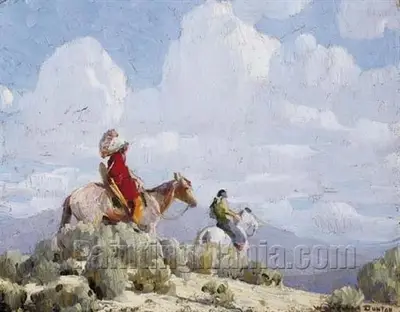
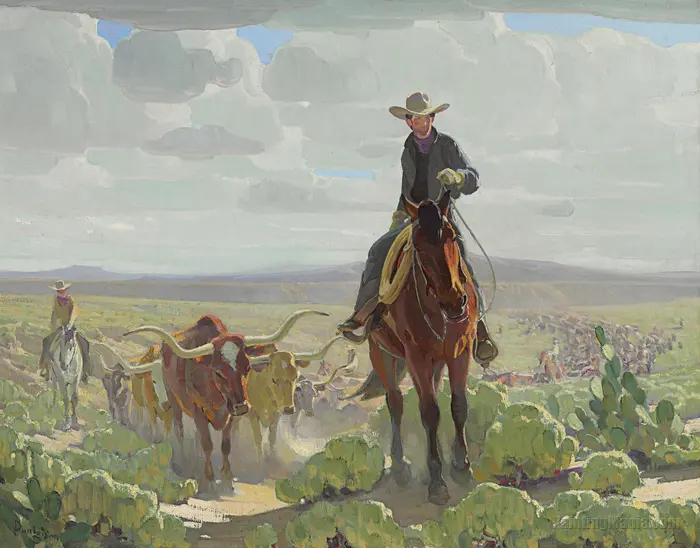
Texas of Old by William Herbert Dunton is one of those images that never dates. Our studio recreates it as a hand painted oil painting — textured, color-rich, and ready to hang as canvas wall art in a hallway, study, or reception area.
circa 1930
Oil on canvas
25? x 32? in. (64.1 x 82 cm.)
The sixth charter member of the Taos Society of Artists, William "Buck" Dunton distinguished himself from his contemporaries by primarily focusing on the fleeting life of the cattle country of the West and Southwest that followed the vanishing era of the American Indian.
Even at a young age, Dunton was recognized for his advanced draftsmanship, and while still a teenager his drawings appeared in local newspapers in Maine as well as the Boston Globe. Following school, Dunton pursued his desire for exploration and thrill-seeking adventure and traveled West to Montana. There, among the cattle outfits, he began an intense study of animal anatomy, carefully rendering in pencil with painstaking detail the musculature, expression, and movement of the horses and wildlife he encountered. The young artist continued to travel throughout the West, covering territories from Oregon down to Mexico, returning to New York in the winter to a career in commercial illustration and classes at the Art Students League under the direction of Ernest L. Blumenschein.
Most likely at the encouragement of Blumenschein, Dunton traveled to New Mexico in 1912. "He was the last of the six pioneer artists to arrive on the Taos scene. He immediately fell to work with a furious energy and established a routine of early rising and steady painting that was to last for the next twenty years...His custom of camping out for days, even weeks, at a time, 'far from the haunts of men,' in search for material for his paintings, was continued throughout his life. The country around Taos, in those days, offered excellent opportunities to study wild animal life, for men were strangers to much of it. Dunton frequently camped and hunted in the back country in all seasons, in all weathers, and probably with minimum equipment--a gun, a bedroll, sketchbook and thumb box." (L.M. Bickerstaff, Pioneer Artists of Taos, Denver, Colorado, 1983, pp. 105-06) Dunton's passionate and deeply concentrated dedication to his subject is evident in a work such as Texas of Old, where he captures the appearance and musculature of his animal subjects and the posturing of the rider set against a Western landscape. In fact, the horse depicted in this painting was Dunton's own, named Skeeter, which allowed the artist many opportunities to study and then to capture a precise rendering. In Texas of Old, this sense of portraiture can be seen in the spirited and accurate turn of the horse's head that displays an exquisitely painted contour highlighted by the glow of the desert light.
According to Dunton scholar, Michael Grauer, "About 1926 we see another stylistic shift in Dunton's work, firmly establishing him as a part of the Regionalist movement in the United States between 1925 and 1945, exemplified by the work of Midwest triumvirate of Thomas Hart Benton, Grant Wood, and John Steuart Curry. Paralleling these artists, especially Wood, and in order to maintain a position as a 'modern' artist, Dunton composed his last paintings while leaning more heavily than ever on the abstract qualities of design and decorative sensibility. Concurrently, he built his compositions on a foundation of 'hard visual data' including using models, making numerous sketches and studies, and taking photographs...By carefully composing his mature paintings Dunton indicated quite clearly that photographic images of the Old West...were not his goal. Instead he 'saved' on canvas his interpretations of the Old West and its inherent values...Both Wood and Dunton hoped to 'instill new magic and charm into old fables,' whether those fables were found in rural Iowa or West Texas, 'so they would not, in the wake of iconoclasts, be lost forever.' Nostalgic paintings such as Texas of Old are examples of this approach of repackaging--and this validating--old themes in a new, 'modern' formal vocabulary."
The monumentality of the rider towering above the cacti and sagebrush in Texas of Old speaks to Dunton's admiration for the cowboy and is directly reminiscent of one the artist's largest and most dramatic scenes, The Cattle Buyer, (Stark Museum of Art, Orange, Texas) painted in 1921. In discussing his inspiration for this work, Dunton commented "the West has passed--more's the pity. In another twenty-five years the old-time westerner will have gone, too--gone with the buffalo and the antelope. I'm going to hand down to posterity a bit of un-adulterated real thing, if it's the last thing I do." (as quoted in Pioneer Artists of Taos, pp. 106-07) Unlike many of his Taos contemporaries, Dunton was concerned less with the native Pueblo culture than in capturing the vanishing frontier life of the American West, as he so beautifully did in Texas of Old, an elegy to the West he loved.
This painting will be included in the forthcoming catalogue raisonné of the artist's work being compiled by Michael R. Grauer.
Collectors often choose this fine art image when searching for fine art oil painting that feels substantial rather than decorative or disposable.
Each canvas is painted entirely by hand with professional oil paints on artist-grade cotton canvas. No printing, giclée, or digital imaging is used at any stage, so the surface keeps the slight relief and color variation of real brushwork.
This fine art oil painting wall decor is equally at home in a residence, a boutique hotel, or a professional office. Its elegant character makes it a safe, distinctive gift for anyone furnishing a hallway.
In short: Texas of Old - William Herbert Dunton - Hand Painted Oil Painting combines an elegant composition, a 100% hand painted oil painting process, and the flexibility of made-to-order canvas sizes — a dependable choice for fine art oil painting and hallway wall art.
| Size | Price |
|---|---|
| 20 X 24 in | $98.48 |
| 24 X 36 in | $153.48 |
| 30 X 40 in | $197.48 |
| 36 X 48 in | $261.98 |
| 48 X 72 in | $506.48 |
The sizes shown are the reproduction canvas sizes we paint to order. The dimensions given in a work's description refer to the original artwork and will differ from the sizes offered here. Not sure? Read the size guide or e-mail us.
Free on orders over $60; a flat $5 below that. Dispatched in 1–2 business days; 30 days to send it back. Full policy.
Every canvas is painted by hand in oils on artist-grade stretched canvas, with an extra blank border left for framing. How to care for your painting.
Measurements are on the size guide, or e-mail [email protected] and we reply within one business day.