Free shipping on orders over $60$5 flat rate under $604 items: 10% off · 8 items: 20% off
You save $98.47
Free shipping over $60 · 30-day returns · Dispatched in 1–2 business days
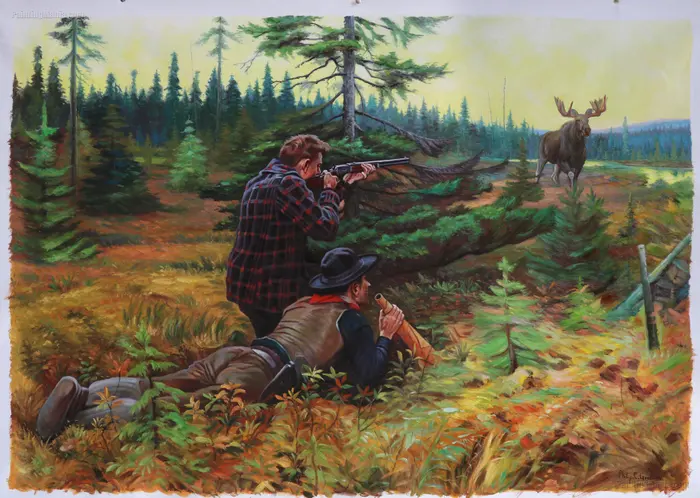
Looking for fine art oil painting with real brushwork? The Northwood King, Calling The Moose is reproduced by hand in oils on artist-grade canvas after Philip Goodwin. The result is a piece of timeless oil painting wall decor that anchors an entryway and rewards a closer look.
Calling the Moose
circa 1912
Oil on canvas
63.5 cm (25 in.) x 91.4 cm (35.98 in.)
Private collection.
Paintings such as The Northwood King by Philip Goodwin provide evidence of his prowess as an artist, established firmly by his studies with, and close observation of, some of the most accomplished Western American artists of the late 19th and early 20th centuries. Having initially studied at the Rhode Island School of Design and the Drexell Institute of Art in Philadelphia, Goodwin caught the attention of illustrator Howard Pyle and was invited to join his new artist colony in Chadds Ford, Pennsylvania. Under the tutelage of Pyle, who was also responsible for educating N.C. Wyeth, Maxfield Parish, Harvey Dunn, Frank Schoonover and others, Goodwin developed a keen appreciation for dramatic subjects and composition.
Following his early success as an illustrator, thanks in part to Pyle’s support, Goodwin set out for New York City, where he took up a studio on 23rd Street and began a notable career as a commercial illustrator. Goodwin’s insatiable love for the outdoors resulted in his connection with like-minded artists who had also settled in the metropolis. Over the next few decades, Goodwin would befriend, learn from and, in some cases, influence Edward Borein, Charles Russell, William Herbert Dunton and Carl Rungius, among others. His quiet and trusting demeanor helped him secure good friends and his talents allowed him to realize significant commissions from agencies such as Brown & Bigelow, magazines and periodicals such as Collier’s and The Saturday Evening Post, as well as the enviable position of illustrator for Jack London’s Call of the Wild and Theodore Roosevelt’s African Game Trails.
Images like The Northwood King represent the culmination of Goodwin’s various experiences. The work exhibits the artist’s foundation in illustration with its high key light in the vibrant sky and accents of red in the figure’s clothing. In subject, accuracy, and dynamic moment, the present work relies heavily on Goodwin’s own experiences in the outdoors with his good friend and mentor Charles Russell. Having spent significant time in the field, including a number of visits to Russell’s Bull Head Lodge on Lake McDonald in northwestern Montana, Goodwin was very familiar with the hunting process. The pair were known to have dressed up on a number of occasions, playfully developing subjects, and having Russell’s wife Nancy document them for future inspirations.
The anatomical exactness of the moose, as well as the use of balanced compositional design in the present work also shows the influence of celebrated American wildlife painter Carl Rungius, with whom Goodwin went on a Canadian hunting expedition in 1911. Goodwin would have been well acquainted with the elements of composition design, as laid down in his formal education and proven by the triangular compositional element seen in The Northwood King. The action of the figure taking aim at the moose leads the viewer back into the composition and the action culminates at the very point of the triangle. This compositional device became characteristic of Goodwin’s most accomplished paintings. The technique, a strict version of which Rungius was known to employ, is further evidenced in the three strong diagonals of the composition established by the reclining guide with the call in hand, the rifle of the hunter and the isolated dark green tree line, set against a vibrant sky, across the top of the composition. When the viewer’s eye follows each diagonal element, he or she is led through the open left-hand portion of the composition, up through the outstretched legs of the guide, and eventually to the rifle, and on to the moose itself. These powerful diagonals heighten the drama, allowing for generations to vicariously live out their adventure fantasies in works like The Northwood King.
The fine art subject is rebuilt stroke by stroke in oil, giving the finished canvas the depth expected of timeless oil painting wall decor.
This is a genuine hand painted oil painting, not a canvas print. Our painters match the palette of The Northwood King, Calling The Moose by eye and build up the fine art forms in thin layers, which is what gives the finished fine art oil painting its luminosity.
Hang this fine art oil painting above a sofa, console, or bed to give an entryway an instant focal point. Its timeless palette works with both minimalist and period interiors, and the piece also makes a considered gift for housewarmings, weddings, and art lovers.
Order The Northwood King, Calling The Moose as a hand painted oil painting on canvas and add lasting timeless character to your entryway. Custom sizes, a digital proof before dispatch, and secure worldwide shipping are included.
| Size | Price |
|---|---|
| 20 X 24 in | $98.48 |
| 24 X 36 in | $153.48 |
| 30 X 40 in | $197.48 |
| 36 X 48 in | $261.98 |
| 48 X 72 in | $506.48 |
The sizes shown are the reproduction canvas sizes we paint to order. The dimensions given in a work's description refer to the original artwork and will differ from the sizes offered here. Not sure? Read the size guide or e-mail us.
Free on orders over $60; a flat $5 below that. Dispatched in 1–2 business days; 30 days to send it back. Full policy.
Every canvas is painted by hand in oils on artist-grade stretched canvas, with an extra blank border left for framing. How to care for your painting.
Measurements are on the size guide, or e-mail [email protected] and we reply within one business day.