Free shipping on orders over $60$5 flat rate under $604 items: 10% off · 8 items: 20% off
You save $89.47
Free shipping over $60 · 30-day returns · Dispatched in 1–2 business days
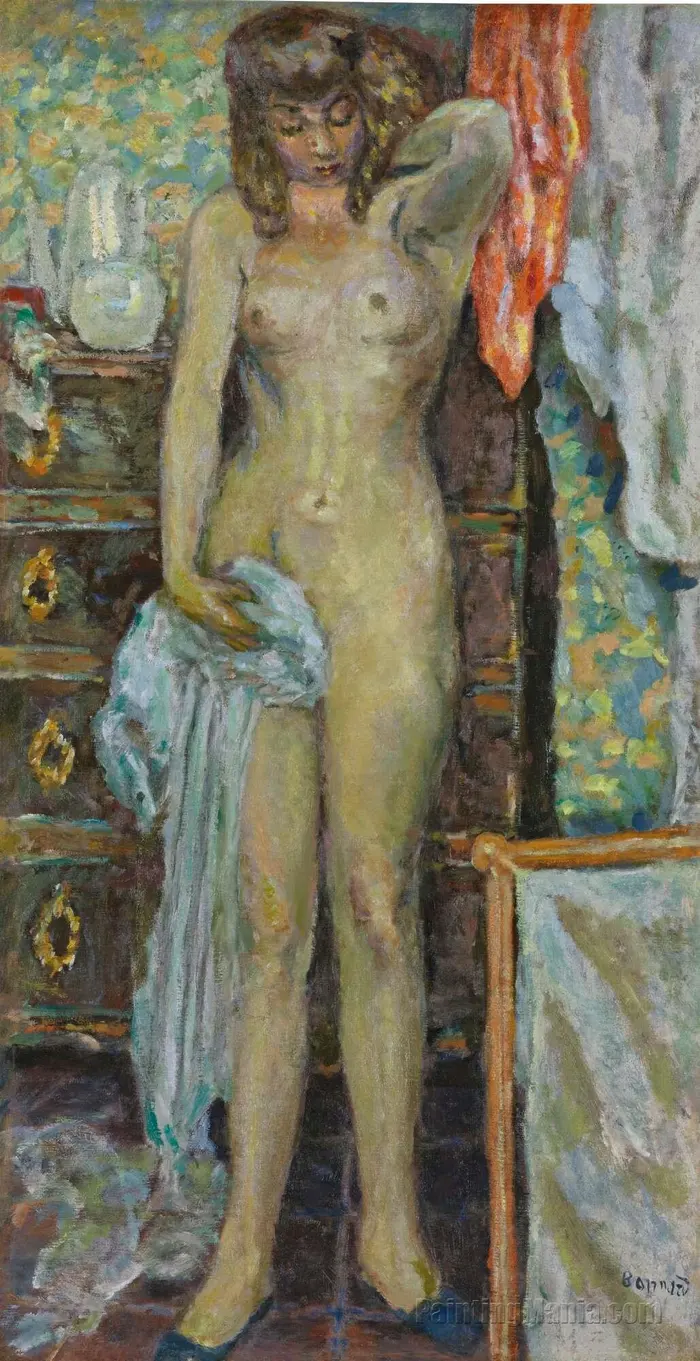
Nothing softens a hallway like a painted surface. The Woman at the Commode by Pierre Bonnard arrives as a hand painted oil painting on canvas, offering the figurative detail, soft gradients, and tactile finish that portrait oil painting shoppers look for.
LA FEMME à LA COMMODE
1909
Oil on canvas
43 3/8 x 23 in.
Private Collection, New York.
La Femme à la commode, painted in 1909, is one of the important canvases that established Bonnard's reputation among avant-garde artists. In this painting the nude is contextualized within the detailed quarters of her living space, as if Bonnard has given us access to the woman's private sanctuary. This picture was among the important early nudes that remained in the private collection of Bonnard's dealer Bernheim-Jeune well into the 1960s. Other examples from this series are now in the collections of major museums throughout the world, including Tate Gallery in London.
The image of a contemporary nude woman at her toilette was an enticing subject for many artists prior to Bonnard, most notably Degas. And like his Impressionist predecessor, Bonnard's approach to painting the nude was aided by referencing sculptures of the human form. The model's pose in the present composition, for example, recalls Michelangelo's Dying Slave, which Bonnard must have seen in the Louvre. But in her consideration of this painting, Sarah Whitfield explained that Bonnard often faced a dilemma when confronted with a nude model, often losing his aesthetic distance. "Personally, I am very weak," Bonnard confessed, "it is difficult for me to control myself in front of the object." Whitfield explains that Bonnard resolved this dilemma by conflating a contemporary image with a historical one in order to distance himself from his subject. She noted that the present painting exemplifies the successful result of this synthesis: "By presenting the nude full-length and frontally, Bonnard makes her resemble a standing sculpture not unlike the small nudes he had made around 1906, in a short-lived experiment with modeling in the round. That experience of working in plaster shows that Bonnard was thinking of the nude in terms of sculpture, and this in turn helped him find in painting the weight and density apprpriate to the human figure without having to work from a model" (S. Whitfield, "Fragments of an Identical World", in Bonnard (exhibition catalogue), Tate Gallery, London, 1998, p. 21).
The model for the present work is presumed to be Bonnard's lover Marthe, who would pose for the artist's most intimate and voyeuristic compositions. Bonnard's best works feature Marthe occupied by a daily routine such as eating, reading, bathing or drying herself after a bath. Among them all, the bather paintings are regarded as Bonnard's most successful. Bonnard met Marthe de Méligny (née Maria Boursin) in 1893, when she was a fashionable young Parisian shop girl, and married her in 1925. Discussing Bonnard's portrayals of Marthe, Sarah Whitfield wrote: "Marthe is almost always seen in her own domestic surroundings, and as an integral part of those surroundings. [...] In a sense many of these works are variations on the theme of the artist and his model as well as on the double portrait. This is the case even when Bonnard is not visible. [...] We are always made acutely aware that whatever the subject of the painting – a nude, a still life, a landscape – what we are being asked to witness (and to participate in) is the process of looking. But it is in the paintings of Marthe above all that we find Bonnard portraying himself as the ever-attentive, watchful presence" (ibid., p. 17).
Our artists reproduce this figurative composition in oil on canvas by hand, preserving the tonal range that makes portrait oil painting so sought after for a hallway.
Trained artists work in stages — underpainting, mid-tones, highlights, and detail — using traditional oils on canvas. Because nothing is printed, every hand painted oil painting has its own subtle texture and depth.
For hallway wall art that does not feel generic, a painted figurative canvas is hard to beat. It is a popular portrait oil painting pick for new homeowners and a durable alternative to seasonal poster art.
In short: The Woman at the Commode - Pierre Bonnard - Post-Impressionist Canvas Wall Art combines a post-impressionist composition, a 100% hand painted oil painting process, and the flexibility of made-to-order canvas sizes — a dependable choice for portrait oil painting and hallway wall art.
| Size | Price |
|---|---|
| 20 X 40 in | $89.48 |
| 24 X 48 in | $127.48 |
| 30 X 60 in | $186.48 |
| 36 X 72 in | $234.48 |
The sizes shown are the reproduction canvas sizes we paint to order. The dimensions given in a work's description refer to the original artwork and will differ from the sizes offered here. Not sure? Read the size guide or e-mail us.
Free on orders over $60; a flat $5 below that. Dispatched in 1–2 business days; 30 days to send it back. Full policy.
Every canvas is painted by hand in oils on artist-grade stretched canvas, with an extra blank border left for framing. How to care for your painting.
Measurements are on the size guide, or e-mail [email protected] and we reply within one business day.