Free shipping on orders over $60$5 flat rate under $604 items: 10% off · 8 items: 20% off
You save $47.97
Free shipping over $60 · 30-day returns · Dispatched in 1–2 business days
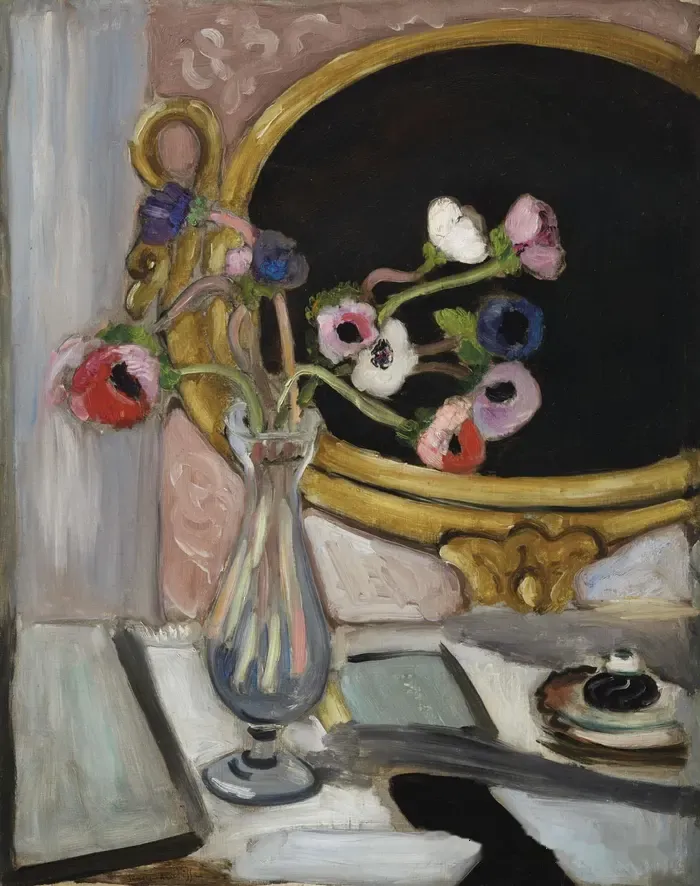
Upgrade your walls with Anemones with a Black Mirror - Henri Matisse - Fine Art Canvas Wall Art. Every fine art reproduction is painted entirely by hand, so the surface carries the depth and variation of an original oil painting rather than the flatness of a digital canvas print.
Anémones au miroir noir
Painted in Nice, 1919
Oil on canvas
26 3/4 x 21 1/4 in. (67.9 x 53.8 cm.)
In December 1918, just a month after the Armistice ending the First World War was signed, Matisse traveled south to Nice for the second consecutive winter, inaugurating a decade-long pattern of seasonal peregrinations that would beget a wholesale transformation in his artistic vision. The previous year, he had taken a room at the modest H?tel Beau-Rivage in the old quarter of the city. Now, he upgraded to the H?tel Méditerranée et de la C?te d’Azur on the ritzy promenade des Anglais, where he would lodge for three working seasons.
The artist’s first room in his new choice of a hotel boasted Italianate décor and a balcony overlooking the sea; in a corner beside the French doors was a small dressing table with an oval, gilt-framed mirror and a muslin skirt. “The table became an important compositional element for Matisse,” Jack Cowart has written, “and he began a faithful, almost poetic relationship with it, portraying the glass often mysteriously black, sometimes crosshatched or fully reflecting. This table became the room’s inhabitant, with or without the model” (exh. cat., op. cit., 1986, p. 24).
In the present still life, painted during Matisse’s early months at the H?tel Mediterranée and sold to Bernheim-Jeune in March 1919, the dressing table and its accoutrements serve as a potent means of disrupting pictorial convention. The composition centers upon the dialogue between the oval mirror and a bouquet of anemones. Instead of reflecting an image back, the mirror, painted black, deepens the background of the interior and allows the blossoms seemingly to float in space.
Though the still-life arrangement is carefully balanced, the eye is drawn repeatedly to the flowers that bloom before the mirror’s blank surface, their coloristic vibrancy heightened by contrast with the inky darkness. Black, in this way, becomes a vehicle for conveying light rather than shadow. “When you put black on the canvas it stays in its plane,” Renoir famously lauded Matisse. “All my life, I thought that one couldn’t use it without breaking the chromatic unity of the surface. As for you, using a colored vocabulary, you introduce black and it holds” (quoted in ibid., p. 20).
When Matisse arrived in Nice in late 1918, he was at a pivotal moment of reassessment and renewal in his career. “My idea is to push further and deeper into true painting,” he wrote to his wife Amélie on 13 January 1919 (quoted in H. Spurling, Matisse the Master, New York, 2007, p. 223). During the First World War, he had come close to pure abstraction in a series of monumental, radically austere canvases; now, nearing age fifty and with his reputation as a leader of the avant-garde firmly established, he was determined to reconquer the ground that he had given up along the way.
“I first worked as an Impressionist, directly from nature; I later sought concentration and more intense expression both in line and color,” he explained to an interviewer back in Paris that June, “and then, of course, I had to sacrifice other values to a certain degree, corporeality and spatial depth, the richness of detail. Now I want to combine it all” (quoted in J. Flam, ed., Matisse on Art, Berkeley, 1995, pp. 75-76).
The H?tel Mediterranée provided Matisse with a fertile, expansive environment for these artistic experiments. “An old and good hotel!” he recounted. “I stayed there four years [1918-1921] for the pleasure of painting. Do you remember the light we had through the shutters? It came from below as if from theater footlights. Everything was fake, absurd, amazing, delicious” (quoted in exh. cat., op. cit., 1986, p. 24). In the present painting, one of the muslin curtains that flanked the French doors is visible at far left; sunlight filters through the sheer white fabric and falls across the dressing table, glinting on the glass vase and creating a patchwork of light and shadow.
This material luminosity—“a light so soft and tender, despite its brilliance,” Matisse wrote to Charles Camoin in 1918—is here contrasted with the black surface of the mirror, which generates an abstract radiance that seems to emanate from the painting itself. The mirror establishes the internal plane of the picture, in counterpoint to the recessive foreground space that contains the floral bouquet. “A will to rhythmic abstraction was battling with my natural, innate desire for rich, warm, generous colors and forms, in which the arabesque strove to establish its supremacy,” Matisse later recalled. “From this duality issued works that, overcoming my inner constraints, were realized in the union of poles” (interview with André Verdet, 1951 in J. Flam, ed., op. cit., 1995, p. 272).
The present canvas is the largest of three contemporaneous still lifes in which Matisse juxtaposed the iconic oval mirror with a slender, elongated glass vase. In one variant, the mirror naturalistically reflects the interior of the artist’s hotel room; in the other, not only the mirror but the entire ground is painted solid black (see exh. cat., op. cit., 1986, pls. 78 and 80, respectively).
The vase may have been one of the supplied furnishings of the H?tel Mediterranée or, more likely, an object that Matisse expressly procured in Nice, perhaps attracted by its feminine curves—a stand-in for the live model—or the way that its shape echoed the decorative balustrade of his room’s balcony. Like Cézanne, Matisse had favorite still-life objects that frequently recurred in his repertory of forms, acting as a controlled set of variables that enabled him to test new pictorial solutions. “All my life I worked in front of the same objects,” he explained, “which gave me the force of reality by directing my mind toward all that these objects had gone through for me and with me” (quoted in Matisse in the Studio, exh. cat., Museum of Fine Arts, Boston, 2017, p. 48).
Every hand painted oil painting in this fine art series is finished on artist-grade canvas and checked against the original before it leaves the studio.
Each canvas is painted entirely by hand with professional oil paints on artist-grade cotton canvas. No printing, giclée, or digital imaging is used at any stage, so the surface keeps the slight relief and color variation of real brushwork.
This fine art oil painting wall decor is equally at home in a residence, a boutique hotel, or a professional office. Its fauvist character makes it a safe, distinctive gift for anyone furnishing an entryway.
Order Anemones with a Black Mirror as a hand painted oil painting on canvas and add lasting fauvist character to your entryway. Custom sizes, a digital proof before dispatch, and secure worldwide shipping are included.
| Size | Price |
|---|---|
| 20 X 24 in | $47.98 |
| 24 X 36 in | $77.98 |
| 30 X 40 in | $104.48 |
| 36 X 48 in | $149.48 |
| 48 X 72 in | $291.98 |
The sizes shown are the reproduction canvas sizes we paint to order. The dimensions given in a work's description refer to the original artwork and will differ from the sizes offered here. Not sure? Read the size guide or e-mail us.
Free on orders over $60; a flat $5 below that. Dispatched in 1–2 business days; 30 days to send it back. Full policy.
Every canvas is painted by hand in oils on artist-grade stretched canvas, with an extra blank border left for framing. How to care for your painting.
Measurements are on the size guide, or e-mail [email protected] and we reply within one business day.