Free shipping on orders over $60$5 flat rate under $604 items: 10% off · 8 items: 20% off
You save $47.97
Free shipping over $60 · 30-day returns · Dispatched in 1–2 business days
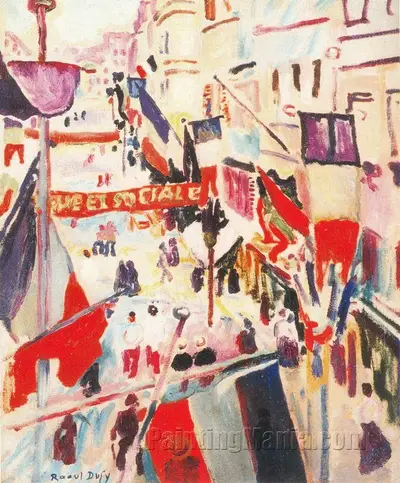
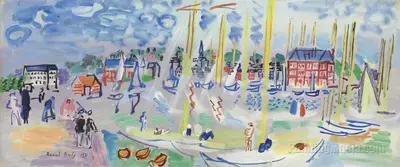
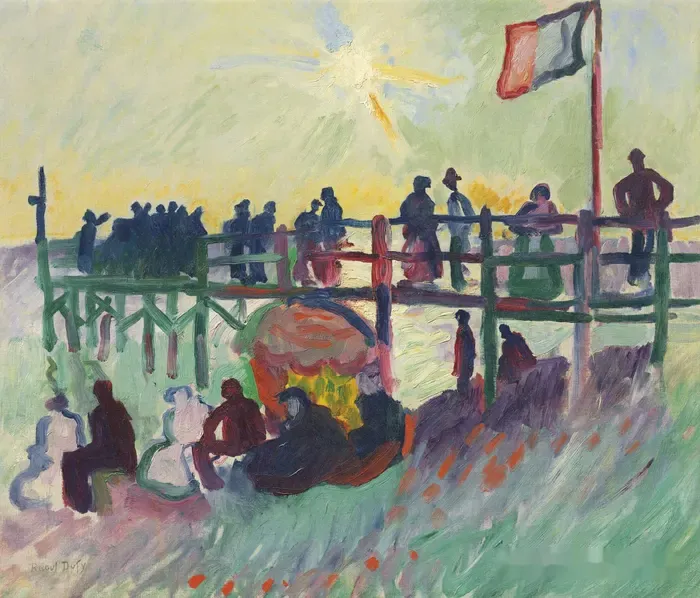
L'estacade au Havre - Raoul Dufy - Oil Painting for Hallway is part of our hand painted oil painting collection from the Raoul Dufy Paintings selection. Each canvas is worked by a trained artist, then inspected before dispatch — a practical route to owning fauvist wall decor at a fraction of gallery pricing.
The Pier in Le Havre, 1905-1906
Oil on canvas
Private collection.
‘Having arrived at some beach subject or other I would sit down and start looking at my tubes of paint and my brushes. How, using these things, could I succeed in conveying not what I see, but that which is, that which exists for me, my reality?’
(Dufy, quoted in D. Perez-Tibi, Dufy, London, 1989, pp. 22-23).
‘What Dufy painted no other artist could have rendered, because no other possessed his gift for receiving and reflecting sensations of pleasure, light, and joy… His fine talent as a painter, his masterly use of smooth, brilliant, shining paint, so light and transparent, shows how perfectly his technique suited his artistic feeling’
(M. Brion, Raoul Dufy: Paintings and Watercolours, London, 1958, p. 6).
Raoul Dufy’s L’estacade au Havre, 1905-1906 is awash with a kaleidoscopic haze of colour. The painting depicts a bustling beach scene in the artist’s hometown, Le Havre: throngs of people mingle and meander across a pier which stretches out into the sea, as others sit pensively upon the sand, reflecting on the glistening water before them. Above them warm rays of sunlight burst through the clouds, shrouding the figures in atmospheric silhouettes. The sea and the sand have been painted with the same swirling brushstrokes; languorously, they dissolve into one another in hues of cobalt blue, crimson, lilac, teal and hints of white. Emerging at a time of important transition in Dufy’s career, this work is one of the first canvases in which the artist began to explore a new, lustrous and free colouristic vocabulary inspired by the ground-breaking art of the Fauvist movement. Dufy had first come across the Fauves in the spring of 1905 at the Salon des Indépendants, where his encounter with Henri Matisse’s seminal painting Luxe, Calme, et Volupté, 1904, had left him mesmerised. Its bold and imaginative use of pure colour encouraged Dufy to free himself from a direct representation of reality and instead push his art into new realms of subjective vision. ‘At the sight of that picture,’ he recalled, ‘I understood the new raison d’être of painting, and Impressionist realism lost all its charm for me as I looked at this miracle of creative imagination at work in colour and line. I immediately grasped the mechanics of art’ (Dufy, quoted in M. Giry, Fauvism: Origins and Development, New York, 1982, p. 135). Returning to his native Le Havre that summer, Dufy’s depictions of life in the coastal hubs of Normandy became invigorated by a new sense of vibrancy and colour.
The Normandy coast had undergone a remarkable transformation during the first half of the nineteenth century as the development of fast rail connections to and from the capital led to the development of a thriving summertime tourist industry in the region. Traditional fishing villages along the C?te Fleurie quickly developed into seaside resorts, complete with new villas, grand hotels and casinos that catered to the fashionable Parisians who travelled in their droves for sojourns by the sea during the summer months. Eugène Boudin and Claude Monet were both drawn to the area in the 1860s and 1870s, and recorded life on the modern beach, painting the holidaymakers as they traversed the promenades and gathered on the sandy beaches to reap the health benefits of the fresh sea air. The works they produced helped to shape the identity of the Normandy coastline in the public imagination, influencing the perception of Parisians looking to escape the overwhelming heat and commotion of city life for the more relaxing seaside location. However, whereas many of the later Impressionist views of the area were selectively edited to emphasise the untouched, idyllic aspects of the landscape, Dufy’s colourful beach scenes from the early 1900s revel in the bustling atmosphere of the holiday resorts. Focusing on the hotels, cafes, and cabanas for hire, as well as the stylish people that populated them, Dufy threw a spotlight on to the vibrant, energetic holiday mood of towns such as Le Havre, Trouville, Deauville, and Sainte-Adresse.
Dufy had shown great artistic promise from an early age. He came from a very musical family and, though an accountant by profession, his father’s great passion lay in his role as an organist for the cathedral of Le Havre. Dufy regularly attended music concerts, and orchestras were amongst his most depicted subjects. A vital source of inspiration on his artistic career, something of the very essence of music can be felt within the artist’s loose and fluid brushstrokes, and his resonating and iridescent use of colour. As Jan Lancaster notes, ‘Dufy had a particular sensitivity to music which carried over into his painting, whether or not the subject was music-related’ (J. Lancaster, Raoul Dufy, Washington, 1983, p. 5). This analogy to music is perhaps best exemplified in his uninhibited Fauvist paintings, and in the present work one can almost feel the rhythm of the undulating figures that rise and fall along the pier and the beachfront, and hear a melody arise from the melding rivulets of colour that shimmer across its pictorial surface. Speaking about this period of transition into Fauvism, Dufy explained: ‘I had previously painted beaches in the manner of the Impressionists, and had reached saturation point, realising that this method of copying nature was leading me off into infinity, with its twists and turns, and its most subtle and fleeting details. I myself was standing outside the picture. Having arrived at some beach subject or other I would sit down and start looking at my tubes of paint and my brushes. How, using these things, could I succeed in conveying not what I see, but that which is, that which exists for me, my reality?’ (Dufy, quoted in D. Perez-Tibi, Dufy, London, 1989, pp. 22-23). It was this desire to translate his personal experience of the landscape onto canvas that drove Dufy to continue his experimentations with this new artistic vocabulary.
The fine art subject is rebuilt stroke by stroke in oil, giving the finished canvas the depth expected of fauvist oil painting wall decor.
Trained artists work in stages — underpainting, mid-tones, highlights, and detail — using traditional oils on canvas. Because nothing is printed, every hand painted oil painting has its own subtle texture and depth.
For hallway wall art that does not feel generic, a painted fine art canvas is hard to beat. It is a popular fine art oil painting pick for new homeowners and a durable alternative to seasonal poster art.
In short: L'estacade au Havre - Raoul Dufy - Oil Painting for Hallway combines a fauvist composition, a 100% hand painted oil painting process, and the flexibility of made-to-order canvas sizes — a dependable choice for fine art oil painting and hallway wall art.
| Size | Price |
|---|---|
| 20 X 24 in | $47.98 |
| 24 X 36 in | $77.98 |
| 30 X 40 in | $104.48 |
| 36 X 48 in | $149.48 |
| 48 X 72 in | $291.98 |
The sizes shown are the reproduction canvas sizes we paint to order. The dimensions given in a work's description refer to the original artwork and will differ from the sizes offered here. Not sure? Read the size guide or e-mail us.
Free on orders over $60; a flat $5 below that. Dispatched in 1–2 business days; 30 days to send it back. Full policy.
Every canvas is painted by hand in oils on artist-grade stretched canvas, with an extra blank border left for framing. How to care for your painting.
Measurements are on the size guide, or e-mail [email protected] and we reply within one business day.