Free shipping on orders over $60$5 flat rate under $604 items: 10% off · 8 items: 20% off
You save $58.47
Free shipping over $60 · 30-day returns · Dispatched in 1–2 business days
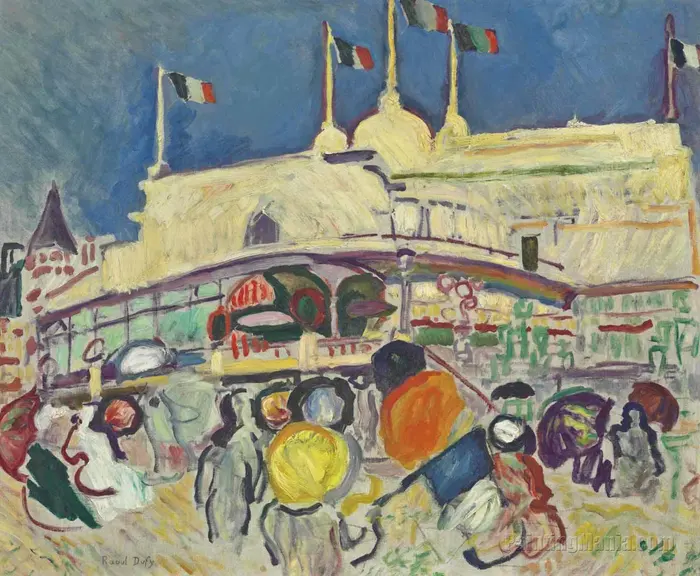
Nothing softens a hallway like a painted surface. Le Casino by Raoul Dufy arrives as a hand painted oil painting on canvas, offering the fine art detail, soft gradients, and tactile finish that fine art oil painting shoppers look for.
1906
Oil on canvas
23 5/8 x 28 1/2 in. (60 x 72.5 cm.)
Private collection.
By 1905, Raoul Dufy had been painting for nearly a decade in an Impressionist idiom, rendering the nuances of the northern light around his hometown of Le Havre in muted, pastel tones, much as Boudin and Monet, two other natives of Le Havre, had done before him. But in March of that year, shortly before his twenty-eighth birthday, Dufy experienced a revelation. At the Salon des Indépendants, he was awestruck by Matisse’s Luxe, calme, et volupté (Musée National d’Art Moderne, Paris), with its boldly subjective organization of pure color. “At the sight of that picture,” he recalled, “I understood the new raison d’être of painting, and Impressionist realism lost all its charm for me as I looked at this miracle of creative imagination at work in color and line. I immediately grasped the mechanics of art” (quoted in M. Giry, Fauvism: Origins and Development, New York, 1982, p. 135).
Back in Le Havre, Dufy put these lessons to work in his own art, introducing more vibrant and expressive color into his trademark coastal scenes. “Until then I had created beaches in the Impressionist style, and I had reached the saturation point with them,” he explained. “[Now] I began to examine my tubes of paint and brushes. With these how can I attain not only what I see but that which is, that which exists for me, my reality?” (quoted in J. Freeman, The Fauve Landscape, exh. cat., Los Angeles County Museum of Art, 1990, p. 94). The sensational Salon d’Automne of 1905–at which the critic Louis Vauxcelles bestowed upon Matisse and his cohorts the derisive sobriquet Les Fauves (“The Wild Beasts”)–confirmed to Dufy that he was on the right path, and by early the next year he was working in a full-blown Fauve manner, applying pure, unmodulated pigments in bold, impetuous strokes.
Dufy painted the present canvas in the summer of 1906, at the very height of the Fauve moment. While many of his Fauve colleagues opted to go south for the season (Matisse to Collioure, for example, and Derain to L’Estaque), Dufy remained in his native Normandy, painting alongside Marquet at Le Havre, Trouville, Honfleur, Dieppe, and Fécamp. Unlike the Midi, this was the Impressionists’ home turf, which Dufy now consciously re-interpreted with brilliantly heightened color. Here, he depicts the Casino Marie-Christine at Sainte-Adresse, a resort suburb of Le Havre, appealingly situated on a high coastal bluff just three miles north of the city center. Although Dufy had painted the casino’s wooden jetty and bathing beach repeatedly since 1901 (Laffaille, nos. 52-60, 132-133), this is his earliest known depiction of the building itself, with its oblong footprint, columnar arcade, and high surmounting dome; he would paint the casino three more times in a cubist idiom between 1910 and 1912 (Laffaille, nos. 319-320, 322).
In the present Casino, Dufy seems to revel in the freedom and excitement of his newfound Fauve technique. The sky is a broad plane of highly saturated blue, rendered all the more intense by its juxtaposition to the creamy white expanse of the building fa?ade and the vermillion stripes of the flags. These flat, even passages of color contrast with the exuberant variety of strokes–hatch marks, arcs, squiggles, and circles–that Dufy uses to describe the bustling crowd of parasol-toting vacationers in the foreground. “He applied his colors unmixed onto the canvas as if in a feverish hurry, striving to convey his emotions as simply and directly as possible,” Marcel Giry has concluded. “The blots of primary colors run over the picture surface like the scrawl of an agitated handwriting or the notes of a passionate symphony” (op. cit., 1982, p. 135).
The fine art subject is rebuilt stroke by stroke in oil, giving the finished canvas the depth expected of fauvist oil painting wall decor.
Oil on canvas remains the reference standard for fauvist reproductions. Our artists apply pigment by hand, blending the fine art tones directly on the surface for depth that a printed fine art oil painting simply cannot match.
fauvist canvas wall art is one of the easiest ways to warm a hallway. Pair this piece with natural linen, dark wood, or brushed brass, and let the hand painted surface do the rest.
Browse our Raoul Dufy Paintings selection for related fine art canvases, or commission this fine art image in a custom size. Every order is a hand painted oil painting, never a printed poster.
| Size | Price |
|---|---|
| 20 X 24 in | $58.48 |
| 24 X 36 in | $91.98 |
| 30 X 40 in | $123.48 |
| 36 X 48 in | $176.98 |
| 48 X 72 in | $329.48 |
The sizes shown are the reproduction canvas sizes we paint to order. The dimensions given in a work's description refer to the original artwork and will differ from the sizes offered here. Not sure? Read the size guide or e-mail us.
Free on orders over $60; a flat $5 below that. Dispatched in 1–2 business days; 30 days to send it back. Full policy.
Every canvas is painted by hand in oils on artist-grade stretched canvas, with an extra blank border left for framing. How to care for your painting.
Measurements are on the size guide, or e-mail [email protected] and we reply within one business day.