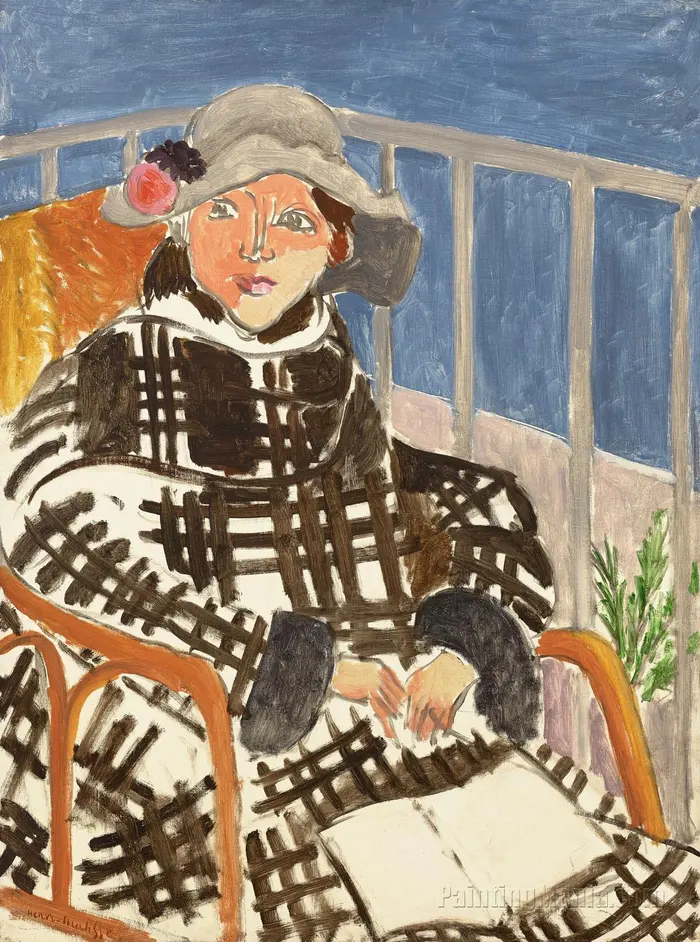
Mademoiselle Matisse in a Plaid Coat by Henri Matisse
You save $58.47
Free shipping over $60 · 30-day returns · Dispatched in 1–2 business days
- Category
- Henri Matisse Paintings
- Color
- —
- Shipping
- Dispatched in 1–2 business days
- SKU
- PM59443-2
Mademoiselle Matisse in a Plaid Coat - Henri Matisse - Hand Painted Oil Painting
Product Overview
Mademoiselle Matisse in a Plaid Coat - Henri Matisse - Hand Painted Oil Painting suits both traditional and modern interiors. As a fine art oil painting, it works as a standalone focal point or as part of a dining room gallery wall, and unlike a print it is genuinely hand painted in oils.
About the Artwork
Mademoiselle Matisse en manteau écossais, spring 1918
Oil on canvas
28 7/8 x 21 5/8 in. (73.5 x 54.9 cm.)
Seeking to escape harsh winter climes of northern France, at the close of 1917 Henri Matisse moved, almost by chance, to Nice. He had traveled south in December to visit his son Jean who was stationed at an airfield outside of Marseille. Owing to the fighting in the north, and “because of the wind” and a case of bronchitis, he left L'Estaque and made his way east along the Riviera where he would remain for almost five months (quoted in op cit., exh. cat., National Gallery of Art, Washington, D.C., 1987, p. 19). “Ah! Nice is a beautiful place!” he wrote to Charles Camoin in May the following year. “What a gentle and soft light in spite of its brightness!” (quoted in ibid, p. 23). So began an infatuation with the south that would continue throughout the rest of his life.
Initially, Matisse installed himself at the H?tel Beau-Rivage, overlooking the Mediterranean and near to the Opéra and the Cours Saleya flower and vegetable markets; the room offered an unobstructed view of the dazzling sea. As in his earliest days in Paris, he made this small space his home and studio while his wife Amélie remained at their house in Issy-Les-Moulineaux. In February or March of 1918, Matisse began renting an apartment next door at 105 quai du Midi (now known as quai des états-Unis). He had only ever intended to stay for three months, a savvy plan in retrospect as the building was requisitioned to house soldiers in May 1918. As a result, Matisse moved to the Villa des Alliés.
During this interim period, Matisse staged multiple paintings in his apartment-cum-studio or out on its small balcony, the setting of Mademoiselle Matisse en manteau écossais. Painted around Easter of that year, the present work features Matisse’s daughter Marguerite wearing a sunhat and sporting a striking plaid coat by the couturiere Germaine Bongard, sister of Paul Poiret and a friend of the artist. Like her brother, Bongard was well established in the avant-garde art world and often hosted exhibitions at the gallery located on the ground floor of her atelier, displaying works by Matisse as well as those of Fernand Léger, Pablo Picasso, and Amedeo Modigliani, among others.
Marguerite and her brother Pierre had arrived in Nice on 7 April to help move their father into 105 quai du Midi. During their visit, she posed several times for paintings, both inside and out on the balcony, wrapped up against the lashing winds and framed by balustrade and sea. Each composition shows a slightly different angle as if Matisse were holding a camera and casting Marguerite in a filmic montage, a continuation of an artistic partnership that had begun in her childhood. Indeed, she had had long been one of her father’s most important subjects, and these portraits chronicle not only her life but Matisse’s artistic and stylistic evolution. Marguerite was, wrote Peter Schjeldahl, “the one person who could command Matisse’s attention” (“Art As Life,” The New Yorker, 29 August 2005).
Having traveled through Morocco, Spain, Russia, and France, Matisse was highly attuned to the ways in which weather and atmosphere affected his output and image of the world; unfortunately, his arrival in Nice coincided with a month of rain. Just as he was about to leave the “mistral chased the clouds away and it was beautiful,” an apt omen for a world emerging from the First World War (Matisse quoted in S. Neilsen Blum, Henri Matisse: Rooms with a View, London, 2010, p. 96). Nice would, as such, prove invigorating for an artist who had long pushed the boundaries of his practice. These would be prolific and pivotal years for Matisse, and the works created following his relocation through to the end of the 1920s were transformative within an already daring and innovative ?uvre.
Enthralled by what he called the city’s “silvered light,” Matisse stayed in the south for the “great colored reflections of January, the luminosity of day-light” (quoted in op. cit., exh. cat., 1987, pp. 23 and 19). He abandoned the flat, planar style of his previous compositions and embraced instead a more subdued palette infused with the warmth of the Mediterranean. Matisse was painting serially during this period, completing one canvas after another, his eye roving generously and freely across his sitters and their settings. Looking to his rooms and their geometries from various vantage points helped to reconfigure his understanding of space itself. Indeed, what makes these early Nice paintings so important is the way Matisse systematically eradicated the space between subject and background. As Dominique Fourcade explained, “Each panel of the painting’s surface is a site of color…and each site of color becomes a source of light that, combined with all the other sources of light, create a wholeness of light and space” (“An Uninterrupted Story,” in J. Cowart and D. Fourcade, op. cit., exh. cat., National Gallery of Art, Washington, D.C., 1987, p. 55).
Mademoiselle Matisse en manteau écossais has an illustrious history. Shortly after it was completed, the painting was acquired by Gaston Bernheim de Villers, son of the important French art dealer Alexandre Bernheim-Jeune, before passing to Walter Taylor, an English watercolor painter and close friend of the artist Walter Sickert. Mademoiselle Matisse en manteau écossais was later in the collection of the esteemed art dealer Sam Salz, himself a close associate of Matisse. The work was acquired by Henry T. Mudd, the businessman, philanthropist, and co-founder of Harvey Mudd College, one of the six Claremont Colleges in southern California. The college educates scientists and engineers, which is fitting seeing as the painting was later owned by Henry Ford II, the son of Edsel Ford I and grandson of Henry Ford I, the founder of Ford Motor Company.
Collectors often choose this fine art image when searching for fine art oil painting that feels substantial rather than decorative or disposable.
Materials & Craftsmanship
This is a genuine hand painted oil painting, not a canvas print. Our painters match the palette of Mademoiselle Matisse in a Plaid Coat by eye and build up the fine art forms in thin layers, which is what gives the finished fine art oil painting its luminosity.
Product Details
- 100% hand-painted oil painting on artist-grade canvas — never a print or digital reproduction.
- A generous 2-inch blank canvas border surrounds the image to simplify mounting.
- Direct-from-studio worldwide delivery with no third-party resellers.
- Available canvas sizes for this hand painted oil painting: 20 X 24 in, 24 X 36 in, 30 X 40 in, 36 X 48 in, 48 X 72 in.
- Any size you need can be produced — just tell us your preferred dimensions.
- Choose from DHL, UPS, FedEx, USPS and other competitively priced carriers.
- We stretch your canvas onto wooden bars at no extra charge, and can arrange custom framing.
- A digital photo of your finished painting is emailed for approval before shipment.
Wall Decor & Gifting
Hang this fine art oil painting above a sofa, console, or bed to give a dining room an instant focal point. Its fauvist palette works with both minimalist and period interiors, and the piece also makes a considered gift for housewarmings, weddings, and art lovers.
Shipping & Guarantee
Sizes & prices
| Size | Price |
|---|---|
| 20 X 24 in | $58.48 |
| 24 X 36 in | $91.98 |
| 30 X 40 in | $123.48 |
| 36 X 48 in | $176.98 |
| 48 X 72 in | $329.48 |
The sizes shown are the reproduction canvas sizes we paint to order. The dimensions given in a work's description refer to the original artwork and will differ from the sizes offered here. Not sure? Read the size guide or e-mail us.
Shipping & returns
Free on orders over $60; a flat $5 below that. Dispatched in 1–2 business days; 30 days to send it back. Full policy.
Materials & craftsmanship
Every canvas is painted by hand in oils on artist-grade stretched canvas, with an extra blank border left for framing. How to care for your painting.
Sizing help
Measurements are on the size guide, or e-mail [email protected] and we reply within one business day.