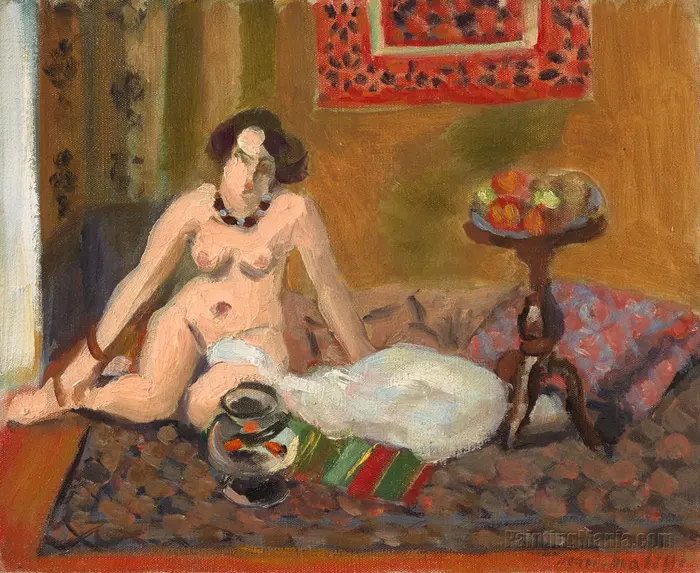
Nude Crouching Near an Aquarium (Nude with Goldfish) by Henri Matisse
You save $47.97
Free shipping over $60 · 30-day returns · Dispatched in 1–2 business days
- Category
- Henri Matisse Paintings
- Color
- —
- Shipping
- Dispatched in 1–2 business days
- SKU
- PM59451-2
Nude Crouching Near an Aquarium (Nude with Goldfish) - Henri Matisse - Oil Painting Wall Decor
At a Glance
Choose Nude Crouching Near an Aquarium (Nude with Goldfish) as a hand painted oil painting and skip the compromise of printed wall decor. Based on Henri Matisse's original. Our artists rebuild the figurative composition stroke by stroke, producing fauvist canvas wall art with lasting color depth.
The Story Behind the Painting
Nu accroupi près d'un aquarium (Nu aux poissons rouges), Nice in 1921-1922
Oil on canvas
Henri Matisse’s 1922 painting Nu accroupi près d'un aquarium (Nu aux poissons rouges) is a celebration of sensual, material pleasure. Here, the artist depicts a voluptuous brunette with a chic bob, wearing a bold blue and red necklace, and little else. His model casually kneels in a richly appointed interior, plush with patterned textiles. She is surrounded by luxurious decorative effects: an exotic, hand-painted folding screen; a red and black tapestry hung against an apricot coloured wall; a platter of fruit arranged on a small wooden table; and a large glass bowl of water, populated by three goldfish. These various objects are united by Matisse’s brilliant command of colour, pattern, and rhythm, harmonizing the overall composition.
The titular still life arrangement in Nu accroupi près d'un aquarium (Nu aux poissons rouges) possesses an important legacy within Matisse’s oeuvre. Beginning in the summer of 1912, Matisse executed at least nine paintings featuring goldfish. These pretty orange fish had been imported to Europe from East Asia since the seventeenth century, and remained popular as pets in the early twentieth century. Matisse kept goldfish in his own studio at Issy-les-Moulineaux, a suburb southwest of Paris. They became a recurring motif in his work; notable examples from this pivotal decade include L’atelier aux poissons rouges (1912, The Barnes Foundation, Philadelphia) and Les poissons rouges et sculpture (1912, The Museum of Modern Art, New York). Both of these early canvases depict a bowl of goldfish and a small sculpture of a reclining female nude; in the present work, however, Matisse transformed the inanimate sculpture into a flesh-and-blood model, who actively engages with the aquarium.
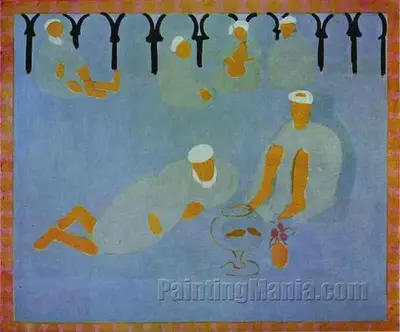
As a Fauvist, Matisse was surely drawn to goldfish in part for their brilliant pigmentation and iridescent sheen; yet his fascination with goldfish was more than a formal exercise. This goldfish series was in fact inspired by the artist’s two trips to Tangier, Morocco in 1912. These experiences were transformative for Matisse – just as similar journeys to North Africa had been for the Romanticist Eugène Delacroix and the Impressionist Pierre-Auguste Renoir in the previous century. During his second trip to Morocco, Matisse was inspired to paint a group of Moroccan men reclining in a café, together looking at a glass filled with goldfish. The resulting work, known as Le café Maure, now belongs to the State Hermitage Museum in Saint Petersburg.
Matisse later recounted his admiration for this calm, contemplative practice he observed in Morocco, which embraces the simple beauty and pleasure of watching fish float, flit and flip through the water. This quiet, visual meditation of nature inspired the same qualities that Matisse hoped to impart to his own work: vivid, mesmerizing tranquillity. In Nu accroupi près d'un aquarium (Nu aux poissons rouges), Matisse replaced the group of Moroccan men with a pale female nude. This model assumes the role of ‘beholder,’ gazing contentedly at the fishbowl before her. In this way, she performs the same act of slow, leisurely looking as that of any viewer faced with Matisse’s painting.
Nu accroupi près d'un aquarium (Nu aux poissons rouges) was painted in 1922, some ten years after Matisse first visited Morocco. By this time, Matisse had rented a studio apartment in Nice in the south of France, where he likely painted the present work. The sitter may be Henriette Darricarrère, whom Matisse frequently employed as a model between 1920 and 1927. Matisse often painted Henriette in the nude, situated in a plush, vaguely orientalised interior, or fully dressed as an odalisque, playing the heroine in the artist’s own elaborate sensual fantasy, inspired by his memories of Morocco. The artist once declared that his odalisque paintings from this period ‘were the bounty of a happy nostalgia, a lovely vivid dream, and the almost ecstatic, enchanted days and nights of the Moroccan climate. I felt an irresistible need to express that ecstasy, that divine unconcern, in corresponding coloured rhythms, rhythms of sunny and lavish figures and colours’ (quoted in J. Flam, ed., Matisse: A Retrospective, New York, 1988, p. 230).
In the same year as its execution, Nu accroupi près d'un aquarium (Nu aux poissons rouges) appeared in an important monographic exhibition of the artist’s work staged at the Galerie Bernheim Jeune in Paris. This painting later belonged to Nelle Mullen, a close colleague of the renowned Philadelphia-based collector Dr Alfred C. Barnes, who acquired a world-famous selection of Impressionist, Post-Impressionist and early modern masterpieces during the early twentieth century. Mullen had begun working for Barnes in 1902, when she was just eighteen, and over the years became one of his most trusted advisors; she was later appointed President of the Board of Trustees at The Barnes Foundation, and continued to champion Barnes's vision until her death. Influenced by her work with Barnes, Mullen built her own collection of important 19th and early twentieth-century paintings and works on paper, including works by Paul Cezanne, Edgar Degas, Pierre-Auguste Renoir, as well as the present canvas.
Collectors often choose this figurative image when searching for portrait oil painting that feels substantial rather than decorative or disposable.
Materials & Craftsmanship
Materials matter for fauvist wall decor. That is why this piece is built on artist-grade canvas with lightfast oil colors, applied by hand rather than output from a printer, and sealed for long-term display.
What Is Included
- 100% hand-painted oil painting on artist-grade canvas — never a print or digital reproduction.
- An extra 2-inch blank border is left around all edges for easy stretching and framing.
- We dispatch worldwide ourselves, so there are no middlemen in the chain.
- Available canvas sizes for this hand painted oil painting: 20 X 24 in, 24 X 36 in, 30 X 40 in, 36 X 48 in, 48 X 72 in.
- Choose from standard sizes or request a custom dimension to fit your wall.
- Multiple low-cost carriers available, including DHL, UPS, FedEx and USPS.
- Complimentary stretching over wooden stretcher bars; ask us about a custom frame.
- A digital photo of your finished painting is emailed for approval before shipment.
Styling & Placement
Style it over a fireplace, behind a reading chair, or along a staircase. Wherever it goes, this fauvist oil painting wall decor adds the layered color that only a hand painted canvas provides.
Ordering & Peace of Mind
Browse our Henri Matisse Paintings selection for related figurative canvases, or commission this figurative image in a custom size. Every order is a hand painted oil painting, never a printed poster.
Sizes & prices
| Size | Price |
|---|---|
| 20 X 24 in | $47.98 |
| 24 X 36 in | $77.98 |
| 30 X 40 in | $104.48 |
| 36 X 48 in | $149.48 |
| 48 X 72 in | $291.98 |
The sizes shown are the reproduction canvas sizes we paint to order. The dimensions given in a work's description refer to the original artwork and will differ from the sizes offered here. Not sure? Read the size guide or e-mail us.
Shipping & returns
Free on orders over $60; a flat $5 below that. Dispatched in 1–2 business days; 30 days to send it back. Full policy.
Materials & craftsmanship
Every canvas is painted by hand in oils on artist-grade stretched canvas, with an extra blank border left for framing. How to care for your painting.
Sizing help
Measurements are on the size guide, or e-mail [email protected] and we reply within one business day.