Free shipping on orders over $60$5 flat rate under $604 items: 10% off · 8 items: 20% off
You save $58.47
Free shipping over $60 · 30-day returns · Dispatched in 1–2 business days
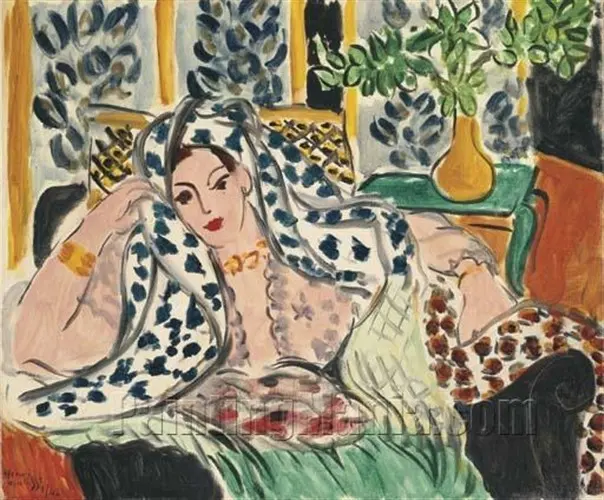
Odalisque with a Black Armchair by Henri Matisse is one of those images that never dates. Our studio recreates it as a hand painted oil painting — textured, color-rich, and ready to hang as canvas wall art in an entryway, study, or reception area.
Odalisque au fauteuil noir, January 1942
Oil on canvas
Private collection, USA.
This painting has been requested for the exhibition Matisse, une seconde vie to be presented at the Musée du Luxembourg, Paris from March to July 2005, and at the Louisiana Museum, Humlebaek, Denmark from August to December 2005.
'I have also begun an important canvas of ma petite princesse,' wrote Matisse on 17 January 1942 in a letter to his friend André Rouveyre, describing his start on the present work, Odalisque au fauteuil noir.
The theme of the odalisque, with its implicit message of heady exoticism, as well as its opportunities for lush colour and sinuous line, held Matisse under an enduring spell. His visits to Spain and North African in the years before 1914 had fed his imagination with a wealth of vivid new subjects, many of which found immediate fruit in masterpieces sold through Bernheim-Jeune to Morosov and Shchukin, his major pre-war Russian patrons.
The importance of the odalisque was also deeply personal: Matisse, as the greatest colourist in modern art, revered Delacroix, the heroic colourist of the nineteenth-century whose Les femmes d'Alger of 1834 in the Louvre, a famous celebration of the odalisque motif, was seen as a central work of the early modern canon. Both Delacroix's freedom with colour and his Orientalist subject matter were enormously influential for Matisse. Fran?oise Gilot, writing in 1964, states: '[Matisse] has always been a frequent visitor to the Louvre, where he had copied the masters during his early years of soul searching...He went back to the large galleries where Delacroix's major works were displayed [including] Les femmes d'Alger... Matisse studied Delacroix's achievements, from the rhythmical arabesques of his compositions to his bold colour contrasts, with passion' (Life with Picasso, New York, 1964, p. 169).
From the 1920s onward, following his move to the Mediterranean coast, the odalisque became a central motif of Matisse's repertoire and the subject of some of his most celebrated works. L'odalisque à la culotte rouge, aiguière, et guéridon (fig. ), painted in 1926, embodies the essence of his obsession, displaying a decorative unity of purpose in common with the present work. The revelry of pattern that both works share also calls to mind a further influence, that of Ingres, whose best female portraiture is often informed with a similarly all-embracing instinct.
Matisse's petite princesse in the present work is the model Nézy. As the great-granddaughter of the sultan Abdul Hamid I, Nézy lived in exile on the C?te d'Azur. Matisse met her by chance one day in Nice as she took a walk with her governess, and she went on to become an important model for him from the late summer of 1940 through to late July 1942. Nézy's Ottoman ancestry meant that she embodied the exotic ideal of the orient more truly than any previous model Matisse had employed. Moreover, the energizing effect that Nézy had on Matisse resulted in a series of luxurious canvases symptomatic of an increased impetus in his art. There exists an intriguing double portrait of Nézy, resplendent in a richly-coloured dress, sitting beside Lydia Delectorskaya, another important muse from Matisse's Nice period (fig. ).
The relationship between the present work and the beautiful Thèmes et variations series of drawings executed by Matisse over 1941 to 1942, and subsequently published by Martin Fabiani in 1943 with an introduction by Louis Aragon, is very evident (fig. ). INneed, the pose of the present work seems linked to the Thème L, and Variation 5 in particular. Matisse drew incessantly at this time with an increasing emphasis on melifluous line, acting in some way as a balance to the super-abundance of colour in his contemporary oils. Odalisque au fauteuil noir felicitously combines the twin concerns of colour and line, conclusively setting them free from the antipathy that had been built up in the academies between the two traditions. Matisse spoke of a 'necessity which has made me persist in trying to find a harmony between drawing, colours and my feeling' (quoted in P. Schneider, Matisse, London, 1984, p. 646).
The sense of music suggested by the Thèmes et variations title is another factor played out in the present work. The dancing melody of line is complemented by visual harmonies established between the various textiles depicted in a delicious evocation of an interior, beneath all of which the white-primed ground is allowed to shine through with confidence.
Matisses's inheritance of sensual orientalism and lyricism leant his art an accessability, a generous inclusiveness that cast onlookers in its thrall and melted away the arguments of opposing camps in admiration of his painterly skill. Picasso, for one, who shared Matisse's sense of wonder in front of Delacroix - and who went on to pay his own artistic homage to Les femmes d'Alger in the 1950s - stated that: 'There are a number of things I shall no longer be able to talk about with anyone after Matisse's death,' and 'All things considered, there is only Matisse' (quoted in Gilot, op. cit., p. 316).
Our artists reproduce this fine art composition in oil on canvas by hand, preserving the tonal range that makes fine art oil painting so sought after for an entryway.
Materials matter for fauvist wall decor. That is why this piece is built on artist-grade canvas with lightfast oil colors, applied by hand rather than output from a printer, and sealed for long-term display.
Style it over a fireplace, behind a reading chair, or along a staircase. Wherever it goes, this fauvist oil painting wall decor adds the layered color that only a hand painted canvas provides.
Whether the search term is fine art oil painting, entryway wall decor, or fauvist oil painting wall decor, this hand painted canvas delivers the same thing: a real painted surface, made to your chosen dimensions.
| Size | Price |
|---|---|
| 20 X 24 in | $58.48 |
| 24 X 36 in | $91.98 |
| 30 X 40 in | $123.48 |
| 36 X 48 in | $176.98 |
| 48 X 72 in | $329.48 |
The sizes shown are the reproduction canvas sizes we paint to order. The dimensions given in a work's description refer to the original artwork and will differ from the sizes offered here. Not sure? Read the size guide or e-mail us.
Free on orders over $60; a flat $5 below that. Dispatched in 1–2 business days; 30 days to send it back. Full policy.
Every canvas is painted by hand in oils on artist-grade stretched canvas, with an extra blank border left for framing. How to care for your painting.
Measurements are on the size guide, or e-mail [email protected] and we reply within one business day.