Free shipping on orders over $60$5 flat rate under $604 items: 10% off · 8 items: 20% off
You save $47.97
Free shipping over $60 · 30-day returns · Dispatched in 1–2 business days
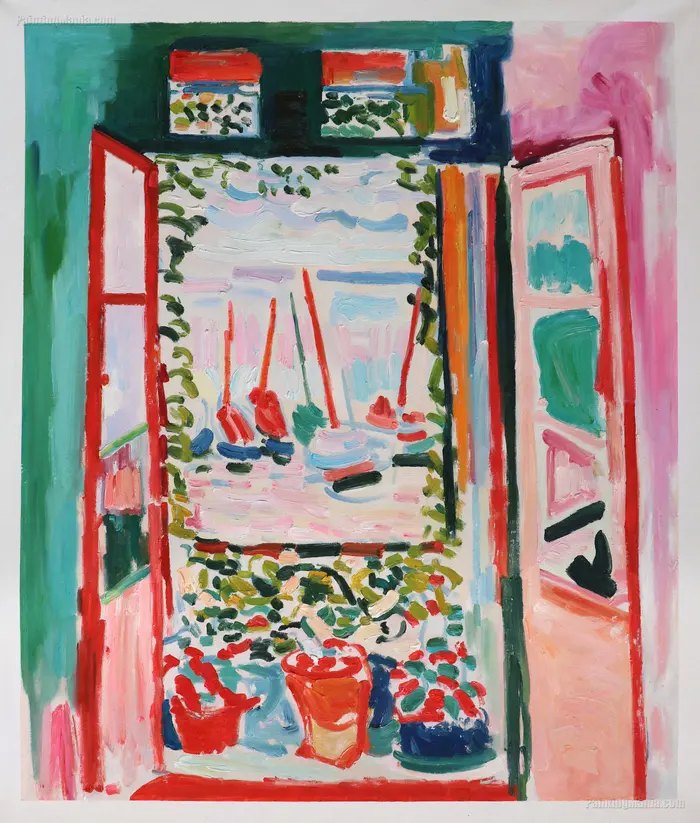
Open Window, Collioure - Henri Matisse - Oil Painting Wall Decor brings gallery-caliber art into everyday spaces. This fine art oil painting is a 100% hand painted oil painting on canvas, created for buyers who want genuine fauvist canvas wall art instead of a mass-produced poster or paper print.
1905
Oil on canvas
National Gallery of Art - Washington DC, United States.
Matisse's Open Window, Collioure is an icon of early modernism. A small but explosive work, it is celebrated as one of the most important early paintings of the so-called fauve school, a group of artists, including André Derain, Maurice de Vlaminck, and Georges Braque, that emerged in 1904. Fauve paintings are distinguished by a startling palette of saturated, unmixed colors and broad brushstrokes. The effect is one of spontaneity, although the works reveal a calculated assimilation of techniques from postimpressionism and neo-impressionism. Open Window represents the very inception of the new manner in Matisse's art. It was painted in Collioure, a small town on the Mediterranean coast of France to which Matisse traveled with Derain in the summer of 1905.
Open Window was exhibited at the landmark Salon d'automne of 1905, where Matisse and other fauve painters were greeted with critical skepticism and public disdain. The "fauve" (savage beast) label itself originated in the art critic Louis Vauxcelles' newspaper review of the exhibition. Vauxcelles, who reproached Matisse for the diminishing coherence of form in his work, praised the artist as "one of the most robustly gifted of today's painters"; his use of the term "fauves," which appears twice, is actually ambiguous: it alludes both to Matisse's fellow painters in Salle VII of the Salon and to the insensitive public, who scorned Matisse's work. Nonetheless, the press was soon referring to Salle VII as a cage aux fauves (cage of wild beasts), and, by 1906, this had become an accepted epithet for Matisse, Derain, and his fellow painters.
The lyrical beauty of Open Window belies the optical and conceptual complexity of the work, in which conventional representation is subordinated throughout by other pictorial concerns. During the time when this work was painted, Derain wrote that even the shadows in Collioure were a "whole world of clarity and luminosity." Matisse courts the maximum intensity of color, essentially eschewing chiaroscuro, the play of light and dark that creates an illusion of volume and spatial depth. Instead, the interior wall surrounding the window is equally divided into broad areas of blue-green and fuchsia, a contrast that is derived from the complementary opposition of green and red on the color wheel (this contrast recurs in the flowerpots at the bottom of the picture). Virtually the same, almost abstract, color relationship occurs in the background of Matisse's The Woman with a Hat (San Francisco Museum of Modern Art), also from this period. Further, Open Window also contains a dazzling variety of brushstrokes, from long blended marks to short, staccato touches. Matisse represented each area of the image - the interior of the room, the window itself, the balcony, the harbor view - with a distinctly different handling of the brush, creating an overall surface effect of pulsating cross-rhythms. Finally, the composition of the work is a series of frames within frames: the wall contains the window; the window frames the middle ground; and the balcony crops the landscape.
Comparing a painting to a window has been a conventional trope in art theory since the Renaissance. In making this comparison the very subject of a picture that is only cryptically representational (by the standards of the day), Matisse allowed Open Window, Collioure to epitomize a new direction in modern art, one in which paintings develop an increasing autonomy from the things they depict. The open window (and the painting-window metaphor) would subsequently become a central motif in Matisse's oeuvre.
As dining room wall art, the piece pairs naturally with other fauvist wall art and with warm neutrals, timber, and soft natural light.
From primer to varnish, the work is done manually on artist-grade canvas. The absence of digital printing is deliberate: it keeps the fine art brushwork visible and gives the fauvist oil painting wall decor a museum-like finish.
As dining room wall art, this canvas brings color and texture without visual noise. It scales well from a small study to a large dining room feature wall, and it is a reliable choice when shopping for fine art oil painting as a gift.
| Size | Price |
|---|---|
| 20 X 24 in | $47.98 |
| 24 X 36 in | $77.98 |
| 30 X 40 in | $104.48 |
| 36 X 48 in | $149.48 |
| 48 X 72 in | $291.98 |
The sizes shown are the reproduction canvas sizes we paint to order. The dimensions given in a work's description refer to the original artwork and will differ from the sizes offered here. Not sure? Read the size guide or e-mail us.
Free on orders over $60; a flat $5 below that. Dispatched in 1–2 business days; 30 days to send it back. Full policy.
Every canvas is painted by hand in oils on artist-grade stretched canvas, with an extra blank border left for framing. How to care for your painting.
Measurements are on the size guide, or e-mail [email protected] and we reply within one business day.