Free shipping on orders over $60$5 flat rate under $604 items: 10% off · 8 items: 20% off
You save $47.97
Free shipping over $60 · 30-day returns · Dispatched in 1–2 business days
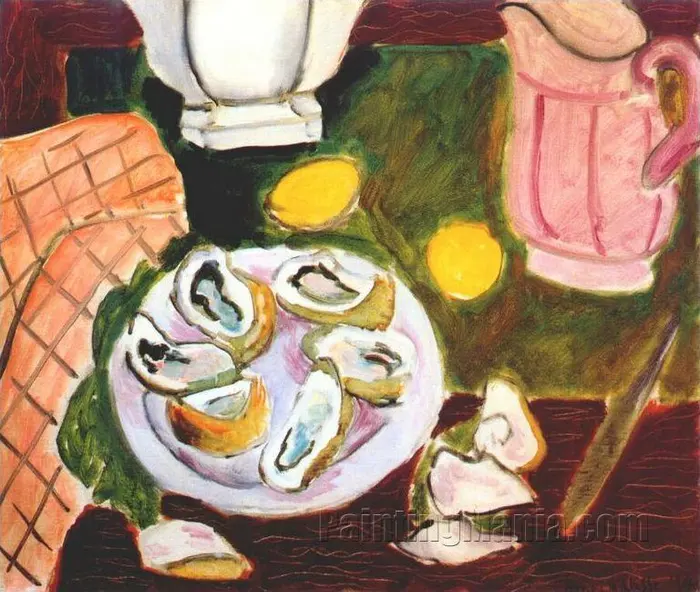
Oysters - Henri Matisse - Oil Painting Wall Decor suits both traditional and modern interiors. As a fine art oil painting, it works as a standalone focal point or as part of a dining room gallery wall, and unlike a print it is genuinely hand painted in oils.
Les huitres, December 1941
Oil on canvas
Over the late summer and autumn months of 1940 and 1941, with the tragedy of the war unfolding and his own life-threatening medical condition necessitating major surgery, Matisse, now living near Nice, embarked on a series of free and expressive still-lifes. Among the first works of the series were three arrangements of oysters in 1940. The most celebrated of this group is today housed in the Kunstmuseum in Basel. Matisse continued the following year with the present work - which is a re-arrangement of most of the Basel elements - as well as such flower pieces as Nature morte au magnolia (Musée national d'art moderne, Paris). The motif of the oyster, surrounded by lemons, napkin and knife, presented Matisse with the opportunity for pure, sensory explorations. 'And for that, my friend', as Matisse wrote to his son, Pierre, 'you need sensations of appetite, a painted oyster must remain to some extent what it is, a spot of the Dutch treatment' (quoted in H. Spurling, A Life of Henry Matisse: The Conquest of Colour, 1909-1954, London, 2005, p. 397).
The present work, with its flat pattern, avoidance of surface depth and tilted picture plane, recalls Matisse's style around 1910 and highlights the regenerative quality of his art. Indeed, the final decade of Matisse's career was one of great productivity. As he wrote to the painter Albert Marquet in 1942, 'My terrible operation has completely rejuvenated and made a philosopher of me. I had so completely prepared for my exit from life, that it seems to me that I am in a second life' (quoted in J. Cowart et al., Henri Matisse: Paper Cut-Outs, exh. cat., St. Louis Art Museum, 1977, p. 43). Likewise, he commented to his friend Jedlicka, 'What I did before this illness, before this operation, always has the feeling of too much effort; before this, I always lived with my belt tightened. What I created afterwards represents me myself: free and detached' (quoted in ibid., p. 43).
Matisse's mastery of colour harmony is reflected in the present work with an unusual arrangement of warm brown, purple and pink offset with sharper hues of acidic yellow and green. 'The aesthetic character of Matisse's conception of colour can readily be analyzed. It is a great deal more difficult to understand his view of the form of objects. His choice of colour harmony seems often to have been based on the whims of his imagination, a desire to translate freely the delight of what he saw in a language whose strength lay in its very simplicity. Apart from an element of na?veté in his art, the techniques he employed in the application of colour have something in common with a typical child's picture. In recognizing that 'drawing is spiritual', he further believed that it was the most intellectual and probably the most difficult element in his art to master for one who 'wanted to be able to use colour as the vehicle for the expression of spritual ideas' (J. Selz, Matisse, New York, 1964, pp. 61-64).
In den Sommer- und Herbstmonaten der Jahre 1940 und 1941, im Schatten des 2. Weltkrieges und geschw?cht von seiner lebensbedrohenden physischen Verfassung, welche verbunden war mit einem schweren operativen Eingriff, schuf Matisse eine beeindruckenden Serie von frei- und expressiv gestalteten Stillleben. Unter den ersten Gem?lden der Gruppe befinden sich drei Arrangemengs von Austern. Das bekanntesten dieser Gruppe befindet sich heute in dem Kunstmuseum Basel, Schweiz. Les hu?tres aus der Samlung Zumsteg war das zweite Werk dieser Gruppe und nimmt ausdruckstark die Hauptelemente der Baseler Variante auf, ebenso wie Elemente aus den Blumenstilleben wie Nature morte au magnolia (Muée national d'art moderne, Paris). Das Motiv der Austern, umgeben von Zitronen, Servierte und Messer betrachtet Matisse unvoreingenommen und sensorisch 'und für das mein Freund' wie Matisse seinem Sohn gegenüber erw?hnt 'braucht man Gefühl, Appetit, eine gemalte Auster muss zu einem gewissen Grade bleiben was sie ist, ein Hauch von niederl?ndischer Malerei' (zitiert aus: H. Spurling A Life of Henry Matisse: The Conquest of Colour, 1909-1954, London, 2005, p. 397)
Das 'Zumsteg' Gem?lde mit seinen fl?chigen Mustern, der Verneinung von Oberfl?chentiefe und die auffallend geneigte Bildebene erinnert an Matisse's Stil der 1910er Jahre und betont somit das Ph?nomen der generativen Qualit?t seiner Kunst. Seinem Künstlerkollegen Albert Marquet gegenüber erw?hnte er 1942 'Meine schreckliche Operation hat mich komplet verjüngt und zum Philosophen werden lassen. Ich hatte mich so vollkommen vorbereitet auf das Ende meines Lebens, dass mir mein jetziges Leben als mein zweites erscheint' (zitiert aus: J. Cowart et al., Henri Matisse:Paper Cut-Outs exh. cat., St. Louis Art Museum, 1977, p. 43). Ebenso sagte er seinem Freund Jedlicka 'Alles was ich vor meiner Krankheit gemacht habe, vor dieser Operation, vermittelt das Gefühl von zu grossem Auswand, vor dem Eingriff hatte ich den Gürtel immer zu eng geschnallt. Alles was ich danach geschaffen haben repr?sentiert mich selbst: frei und unabh?ngig' (zitiert aus: ibid., p. 43)
Matisse's brilliante Beherrschung der Harmonie der Farbe pr?sentiert sich in dem 'Zumsteg' Gem?lde in dem ungew?hnlichen Arrangement aus warmen Braun-, Violet- und Pinkt?nen im Gegensatz zu Partien von hell leuchtendem Gelb und Grün. 'Der ?sthetische Charakter von Matisse's Konzeption von Farbe kann leicht analysiert werden. Dagegen ist es viel schwieriger seine Formgebung zu begreifen. Seine Wahl der Farbharmonie scheint oft einfach auf Launen seiner Imagination zu beruhen, der Wunsch das Vergnügen was er empfand, in eine Sprache zu uubersetzen, deren St?rke in der Einfachheit lag. Neben den Elementen der Naivit?t in seiner Kunst, hat seine Technik des Farbauftrages einiges gemein mit der typischen Art eines Kinderbildes. In Anerkennung, da? 'Zeichnungen spirituell sind' war er zudem überzeugt, dass es das intellektuellste und wahrscheinlich das schwierigste Element seiner Kunst war, Farbe als Ausdruckmittel spiritueller Ideen zu nutzen' (J. Selz, Matisse, New York, 1964, pp. 61-64).
The fine art subject is rebuilt stroke by stroke in oil, giving the finished canvas the depth expected of fauvist oil painting wall decor.
Each canvas is painted entirely by hand with professional oil paints on artist-grade cotton canvas. No printing, giclée, or digital imaging is used at any stage, so the surface keeps the slight relief and color variation of real brushwork.
This fine art oil painting wall decor is equally at home in a residence, a boutique hotel, or a professional office. Its fauvist character makes it a safe, distinctive gift for anyone furnishing a dining room.
In short: Oysters - Henri Matisse - Oil Painting Wall Decor combines a fauvist composition, a 100% hand painted oil painting process, and the flexibility of made-to-order canvas sizes — a dependable choice for fine art oil painting and dining room wall art.
| Size | Price |
|---|---|
| 20 X 24 in | $47.98 |
| 24 X 36 in | $77.98 |
| 30 X 40 in | $104.48 |
| 36 X 48 in | $149.48 |
| 48 X 72 in | $291.98 |
The sizes shown are the reproduction canvas sizes we paint to order. The dimensions given in a work's description refer to the original artwork and will differ from the sizes offered here. Not sure? Read the size guide or e-mail us.
Free on orders over $60; a flat $5 below that. Dispatched in 1–2 business days; 30 days to send it back. Full policy.
Every canvas is painted by hand in oils on artist-grade stretched canvas, with an extra blank border left for framing. How to care for your painting.
Measurements are on the size guide, or e-mail [email protected] and we reply within one business day.