Free shipping on orders over $60$5 flat rate under $604 items: 10% off · 8 items: 20% off
You save $58.47
Free shipping over $60 · 30-day returns · Dispatched in 1–2 business days
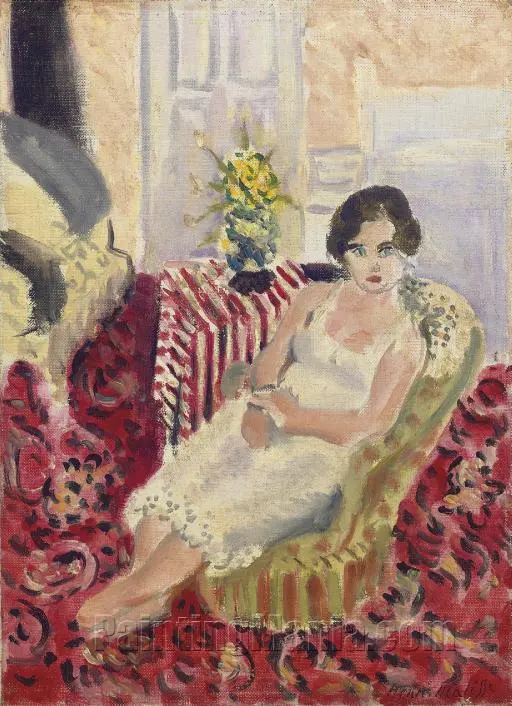
Nothing softens a home office like a painted surface. Seated Figure, Striped Carpet by Henri Matisse arrives as a hand painted oil painting on canvas, offering the figurative detail, soft gradients, and tactile finish that portrait oil painting shoppers look for.
Figure assise, tapis rayé, 1920
Oil on canvas
In 1919, Matisse left Nice temporarily for London to design the costumes and décor for Serge Diaghilev's ballet Le chant du rossignol. When he returned in December of that year, his Southern paradise was not as he had left it. His mentor Pierre-Auguste Renoir, whom Matisse had visited "all through the spring of 1919 in his house, Les Colettes, at Cagnes" had died just a week before (H. Spurling, Matisse the Master: A Life of Henri Matisse: The Conquest of Colour, 1909-1954, London, p. 216). Matisse's usual room at the H?tel de la Méditerranée was unavailable, and the new room had smaller windows and no balcony. His favorite young model Antoinette Arnoud had become otherwise employed, leaving Matisse with a succession of lesser subjects. And in late January 1920, Matisse's mother died, while his daughter Marguerite's laryngo-tracheal problems worsened.
It is no wonder, then, that the artist took comfort in all those things that "stimulated him most: female models, secluded interiors, flowers, and, above all, light" (N. Watkins, "Matisse: The Early Years in Nice," The Burlington Magazine, 1987, p. 273). If Matisse once famously likened the effect of a visually-pleasing painting to "a good armchair which provides relaxation," the armchair in the present painting can be seen as the artist's own respite from real-life concerns. Indeed, the empty seat in the canvas's upper left seems to beckon the viewer, offering a place of rest within the room's sumptuous surroundings.
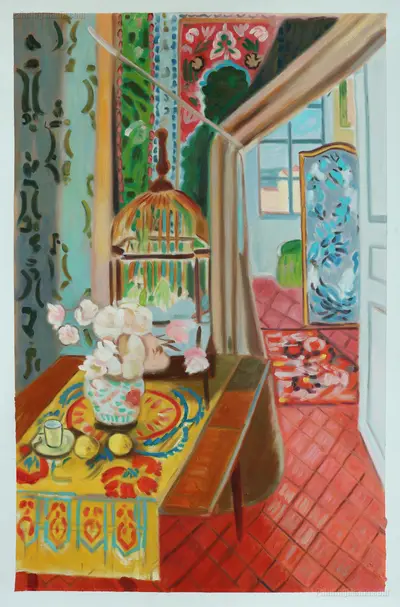
In his essay "Matisse and the Metaphysics of Decoration," Jack Flam points to "the interaction between various levels of materiality in Matisse's painting," which creates "an interpenetration between the imaginary pictorial world of the cloth and the tangible world of real objects" (in Matisse, His Art and His Textiles: The Fabric of Dreams, exh. cat., Royal Academy of Arts, London, 2004, pp. 34 and 37). In the present work, this idea is illustrated by the close visual relationship between the carpet's decorative floral pattern and the real flowers in the vase on the table. Both are executed through the same combination of short strokes and quick dabs. The real flowers' cheerful yellow, however, contrasts with the deeper tones of the rug. These warm reds and pinks can be seen as a tribute to the work of Renoir, Matisse's recently deceased mentor.
The combination of this floral carpet with the room's red and white striped tablecloth creates a lively juxtaposition. The stripes do find, however, a soothing parallel with the vertical lines at the base of the central chair. This striped tablecloth can be seen in a number of Matisse's canvases of the period, and tracing it throughout his oeuvre is as instructive as it is amusing. In Le peintre et son modèle, intérieur d'atelier from the previous year (fig. 1), this cloth becomes part of an even busier rhythm, and sets off a nude model whose her arms stay unabashedly at her sides, instead of protectively folded. In Le petit déjeuner, also from 1920 (fig. 2), the tablecloth is moved to the extreme foreground, while the decorative floral pattern is shifted from carpet to wallpaper. As in the present painting, the model seems almost caught between these two aggressively dynamic designs. If scholars have often interpreted Matisse's decorative patterns as music, then the model's simple white shift represents a note of silence.
Every hand painted oil painting in this figurative series is finished on artist-grade canvas and checked against the original before it leaves the studio.
Trained artists work in stages — underpainting, mid-tones, highlights, and detail — using traditional oils on canvas. Because nothing is printed, every hand painted oil painting has its own subtle texture and depth.
For office wall decor that does not feel generic, a painted figurative canvas is hard to beat. It is a popular portrait oil painting pick for new homeowners and a durable alternative to seasonal poster art.
Order Seated Figure, Striped Carpet as a hand painted oil painting on canvas and add lasting fauvist character to your home office. Custom sizes, a digital proof before dispatch, and secure worldwide shipping are included.
| Size | Price |
|---|---|
| 20 X 24 in | $58.48 |
| 24 X 36 in | $91.98 |
| 30 X 40 in | $123.48 |
| 36 X 48 in | $176.98 |
| 48 X 72 in | $329.48 |
The sizes shown are the reproduction canvas sizes we paint to order. The dimensions given in a work's description refer to the original artwork and will differ from the sizes offered here. Not sure? Read the size guide or e-mail us.
Free on orders over $60; a flat $5 below that. Dispatched in 1–2 business days; 30 days to send it back. Full policy.
Every canvas is painted by hand in oils on artist-grade stretched canvas, with an extra blank border left for framing. How to care for your painting.
Measurements are on the size guide, or e-mail [email protected] and we reply within one business day.