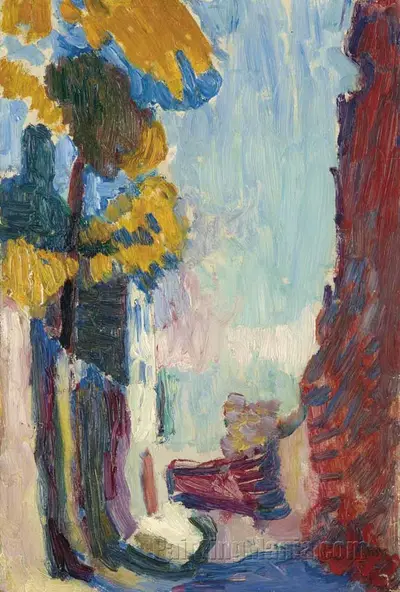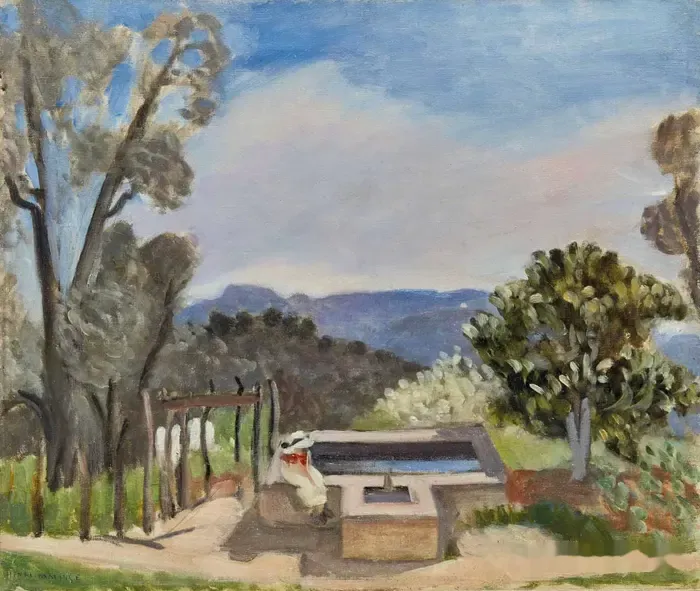
The Fish Pond (Landscape of Provence) by Henri Matisse
You save $47.97
Free shipping over $60 · 30-day returns · Dispatched in 1–2 business days
- Category
- Henri Matisse Paintings
- Color
- —
- Shipping
- Dispatched in 1–2 business days
- SKU
- PM59484-2
The Fish Pond (Landscape of Provence) - Henri Matisse - Wildlife Canvas Wall Art
Product Overview
The Fish Pond (Landscape of Provence) - Henri Matisse - Wildlife Canvas Wall Art brings gallery-caliber art into everyday spaces. This wildlife oil painting is a 100% hand painted oil painting on canvas, created for buyers who want genuine fauvist canvas wall art instead of a mass-produced poster or paper print.
The Story Behind the Painting
Le vivier (Paysage de Provence), 1923
Oil on canvas
The 1920s presented a new direction for Matisse, having moved to Nice in the South of France in 1917, towards the end of the First World War. Matisse was by this time a well-recognised artist, long in the wake of his Fauve days which bought he, André Derain and Maurice Vlaminck to critical visibility in the first decade of the new century. His breakthrough at that time would culminate in subsequent masterpieces on the brink of abstraction in the 1910s. It was after these radical departures, shortly after finishing his magnum opus Bathers by a River that Matisse reached an impasse, as described by Hilary Spurling: “At the height if his powers in the darkest period of the war, he reached the end of a process begun twenty years before by bringing painting to the verge of pure abstraction. He had emerged triumphantly from the most gruelling phase of his career with a batch of works so far ahead of public taste and critical comprehension that some of them would not be fully understood, even by other artists, for decades to come. But he had some simultaneously painted himself into a corner from which there was no obvious way out.” (H. Spurling, Matisse, the Life, London, 2009, p. 294)
By 1923, Matisse was caught in a struggle to retain his own sense of artistic progression, outside the warring external forces of commercial success and critical judgement. Whilst demand for his recent work increased from collectors and Paul Durand-Ruel of Galerie Bernheim-Jeune, Matisse experienced criticism from his avant-garde contemporaries who considered that he had regressed into a more commercially palatable style of colourful nudes and flowers which rejected the hard-won appreciation of his ostensibly more risqué, early work. Feeling misunderstood and isolated in his new line of enquiry, Matisse nonetheless continued along the path of his own creative truth that would ultimately lead to his revolutionary cut-outs in the early 1940s. His enduring love of Impressionism and the newly abundant nature of his surroundings bought him back into a sensuality of flesh and the beauty of the landscape which would inspire his next phase of chromatic experimentation.
Upon leaving Paris in 1917, Matisse took this new direction, comprehended by some as a rappel a ordre, which was not only a response to the bleak situation in his homeland but an attempt to rejuvenate his practice on his own terms, following his own artistic intuition. His new situation in Nice bought Matisse to his first meeting with Auguste Renoir in 1917, whom he would continue to visit until the master’s death in 1919. Renoir’s influence, as that of other impressionist artists he had worked with, would continue to exert itself on Matisse’s artistic consciousness. As Spurling explains, “Impressionism, which had effectively blocked off the future in the Fauve years, now suggested a way forward. ‘Renoir’s work saves us from the drying-up effect of pure abstraction,’ said Matisse, explaining to an interviewer that once you have explored as far as you can go in a particular direction, you have to change course. From now on, the problems resolved with such labour in the great radical canvases of 1916-17 ceased to interest him.” (H. Spurling, ibid, p. 316).
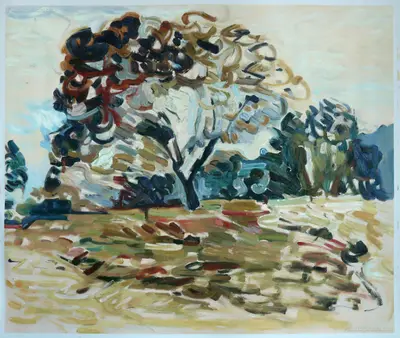
Though much of Matisse’s work at this time was dedicated to nudes within the studio, depicting odalisques within elaborately staged settings, a number of landscapes also appear during this time from his escapades into nature. Le vivier, shares similar compositional devices as used by Renoir in works such as Les collettes from 1908 (fig. 1). Matisse depicts a small, solitary figure, situated peacefully within an abundant and distinctly southern landscape, bathed in Mediterranean light. In both compositions, the figure is dwarfed by nature and yet a part of it, painted in the same palette as their surroundings. In Le vivier, Matisse heightens the red on the collar against the bright white of his sitter’s clothing as an accent to project her more clearly, yet grounding her within the earthy reds of the foreground. The dappled tree to the right of Matisse’s composition shows a deftness of handling and depth of light, contrasted with the larger, monochrome tree to the left; a compositional framing device also employed by Renoir in its inverse in Les collettes. Both images purvey a sense of harmony and beauty however Matisse’s distinct broadness of hand and directness of colour remain.
In a similar composition from the year prior, Painter in the Olive Grove (fig. 2), Matisse depicts an artist within the landscape in a similar manner. Greater contrast is employed between the trees, the shadows and the landscape, lending strong abstract qualities. The solitude of the sitter once again engenders a sense of the sublime among the grand and vast landscape, indicated by the faraway hills. In depicting a painter, there is a self-referential quality to this composition in a similar way to Le vivier, the subtle sense of isolation and meditation common to both works. As such, nature can be seen to remain as the eternal refuge for Matisse at this time in his life. The light and palette used to describe both compositions shows Matisse’s great delight in his new environment and the reason he cited for moving there, “the sunlight: clear, silvery and soft in spite of its phenomenal brilliance” (quoted in H. Spurling, ibid, p. 316).
Collectors often choose this wildlife image when searching for wildlife oil painting that feels substantial rather than decorative or disposable.
Materials & Craftsmanship
From primer to varnish, the work is done manually on artist-grade canvas. The absence of digital printing is deliberate: it keeps the wildlife brushwork visible and gives the fauvist oil painting wall decor a museum-like finish.
Specifications & What You Receive
- Painted entirely by hand in oils on artist-grade canvas, with no giclée or inkjet process involved.
- An extra 2-inch blank border is left around all edges for easy stretching and framing.
- Studio-direct pricing and worldwide shipping on every wildlife oil painting order.
- Quick turnaround — most in-stock wildlife paintings ship in 3–10 working days.
- Available canvas sizes for this hand painted oil painting: 20 X 24 in, 24 X 36 in, 30 X 40 in, 36 X 48 in, 48 X 72 in.
- Made-to-measure options are available for this wildlife canvas.
- Multiple low-cost carriers available, including DHL, UPS, FedEx and USPS.
- Free professional stretching on wooden stretcher bars — contact us for framing options.
- A digital photo of your finished painting is emailed for approval before shipment.
Where to Hang It
As dining room wall art, this canvas brings color and texture without visual noise. It scales well from a small study to a large dining room feature wall, and it is a reliable choice when shopping for wildlife oil painting as a gift.
Shipping & Guarantee
Browse our Henri Matisse Paintings selection for related wildlife canvases, or commission this wildlife image in a custom size. Every order is a hand painted oil painting, never a printed poster.
Sizes & prices
| Size | Price |
|---|---|
| 20 X 24 in | $47.98 |
| 24 X 36 in | $77.98 |
| 30 X 40 in | $104.48 |
| 36 X 48 in | $149.48 |
| 48 X 72 in | $291.98 |
The sizes shown are the reproduction canvas sizes we paint to order. The dimensions given in a work's description refer to the original artwork and will differ from the sizes offered here. Not sure? Read the size guide or e-mail us.
Shipping & returns
Free on orders over $60; a flat $5 below that. Dispatched in 1–2 business days; 30 days to send it back. Full policy.
Materials & craftsmanship
Every canvas is painted by hand in oils on artist-grade stretched canvas, with an extra blank border left for framing. How to care for your painting.
Sizing help
Measurements are on the size guide, or e-mail [email protected] and we reply within one business day.