Free shipping on orders over $60$5 flat rate under $604 items: 10% off · 8 items: 20% off
You save $79.47
Free shipping over $60 · 30-day returns · Dispatched in 1–2 business days
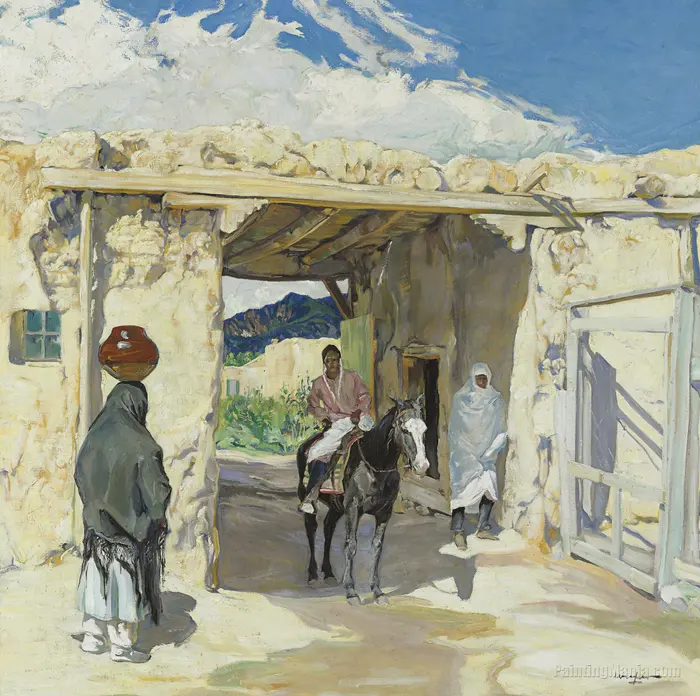
Upgrade your walls with The Gateway - Walter Ufer - Oil Painting Wall Decor. Every fine art reproduction is painted entirely by hand, so the surface carries the depth and variation of an original oil painting rather than the flatness of a digital canvas print.
1918
Oil on canvas
30 x 30 in. (76.2 x 76.2 cm.)
The Columbian Exposition of 1893 in Chicago inspired broad national pride as well as a regional movement for artists to represent the wealth of diverse communities comprising the American identity. Regionalist developments and schools of artists in the west, south, and mid-west began sprouting up, each with their own unique palette and manner of capturing the notion of the "American" landscape and its inhabitants.
Ufer found in New Mexico a wealth of imagery and his first works from Taos demonstrated an immediacy and strength. "These pictures also displayed those qualities that American critics had associated with the 'modern' in painting ever since the first impact of Munich had been felt in the seventies: the rich, painterly surface, broad treatment of details, massing of paint to create substance and suggest tactile qualities, boldness and fluidity of execution and virtuoso brushwork. Ufer thus demonstrated a stylistic affinity to Henri and his followers, whose work often recalled the American pioneers in Munich. In a painting like 'A Daughter of San Juan Pueblo,' his finest painting from this first summer, there is a direct and vital apprehension of personality, a psychological immediacy that is couched in much the same technical terms as a portrait by Henri or Luks or Bellows. The impact, not surprisingly, is similar. It was this quality that would set Ufer's work apart in style and tone from much of the painting in Taos which preceded him." (S.L. Good in Pioneer Artists of Taos, Denver, Colorado, 1983, p. 128)
Ufer's paintings received much favorable criticism, and a positive reception, beginning with the Martin B. Cahn Prize at the Art Institute of Chicago in 1916. His paintings were twice shown at the Venice Biennale, and in 1920, he became the first of the New Mexico artists to win a prize at the prestigious Carnegie International in Pittsburgh. For him, painting was part of a vision of a regional movement and a part of a struggle for a national art. His modernity had roots in Europe but it evolved out of his experience in the Southwest. Writing about the possibilities of a national art, a concern which had challenged creative Americans from the earliest days of national independence, Ufer noted: "I believe that if America gets a National Art it will come more from the Southwest than from the Atlantic Board. Because we are really different from Europeans, and the farther away from European influence, the better for us. We already have too much of Indian blood within our veins to be classed with Europeans, though we are a white race. They are a mixture over there. But we are a different mixture. The strong beauty that the Southwest holds, connected with what the early Spaniard found here when he conquered these people, is what holds us out here rather than painting fishing smacks in the east or Pacific slope." (Macbeth Gallery, exhibition catalogue, New York, 1928)
"Ufer, Blumenschein and Higgins certainly had no difficulty in regarding themselves as modern artists in the late teens, for during this period in America artists were able to define modernity in a number of different ways. One...was through realism of the Ashcan variety, the attempt to look truthfully and frankly at contemporary life without idealizing or sentimentalizing it. Another involved the legacy of Munich and the Paris of Manet: fluid brushwork, a unified, 'sensuous' paint surface, the direct creation of form without resort to academic modeling devices." (Pioneer Artists of Taos, p. 16) Like the vigorous compositions and gritty realism of famed Aschan artist George Bellows (fig. 1), Ufer's work offers an honest and spontaneous depiction of American regional life. The composition of The Gateway creates tension and a visually intriguing narrative, inviting the viewer to walk directly into the scene and wander along converging diagonal lines through the archway towards the distant mountains. There is no additional ornamentation in the scene to distract the eye or appeal to commercial taste, rather just a frank and original snapshot into the contemporary life of the American Indian. The freshness of The Gateway is further underscored by Ufer's energized palette and brushwork balanced against the dynamic symmetry of the composition. The undulating shadows seem to bend with the constantly changing light characteristic of the Southwest, and the wispy clouds overhead float off of the picture plane, almost mirroring the foreground spilling out to the viewer to reiterate the harmony of man and nature.
"Much of Taos painting in fact shared this prevailing mood of fin-de-siecle American art," writes Good, "reaching back as it did to the Barbizon vision of man and nature intertwined, which some Taos painters found perfectly expressed in the life of the Pueblo Indians." The Gateway masterfully embodies a current and relevant American art, a break from a now passé tradition of earlier European and American romantic depictions of man and his environs. Ufer still lends a subtle monumentality and thoughtfulness to his figures, so they exist within their history and culture. "They seem suspended in a sort of elegiac tranquility, evoking bittersweet sentiments of loss and sadness. These paintings, often executed with superb technical means, give the sense of an exalted, refined realm of values, a world at once exotic and safely domesticated, which a powerful American society had subdued and left behind, but still held in redemptive brace." (Pioneer Artists of Taos, p. 14)
Collectors often choose this fine art image when searching for fine art oil painting that feels substantial rather than decorative or disposable.
Expect subtle, hand-made variation rather than factory uniformity. Each fine art canvas is painted with oils, allowed to cure properly, and inspected before it is approved for shipment.
Wondering where fine art oil painting looks best? Try a dining room mantel, a dining room sideboard, or a hallway gallery wall. The fine art subject reads clearly from a distance and rewards close viewing up near.
Order The Gateway as a hand painted oil painting on canvas and add lasting classic character to your dining room. Custom sizes, a digital proof before dispatch, and secure worldwide shipping are included.
| Size | Price |
|---|---|
| 20 X 20 in | $79.48 |
| 24 X 24 in | $91.48 |
| 30 X 30 in | $132.48 |
| 36 X 36 in | $199.98 |
| 40 X 40 in | $240.98 |
| 48 X 48 in | $322.98 |
The sizes shown are the reproduction canvas sizes we paint to order. The dimensions given in a work's description refer to the original artwork and will differ from the sizes offered here. Not sure? Read the size guide or e-mail us.
Free on orders over $60; a flat $5 below that. Dispatched in 1–2 business days; 30 days to send it back. Full policy.
Every canvas is painted by hand in oils on artist-grade stretched canvas, with an extra blank border left for framing. How to care for your painting.
Measurements are on the size guide, or e-mail [email protected] and we reply within one business day.