Free shipping on orders over $60$5 flat rate under $604 items: 10% off · 8 items: 20% off
You save $47.97
Free shipping over $60 · 30-day returns · Dispatched in 1–2 business days
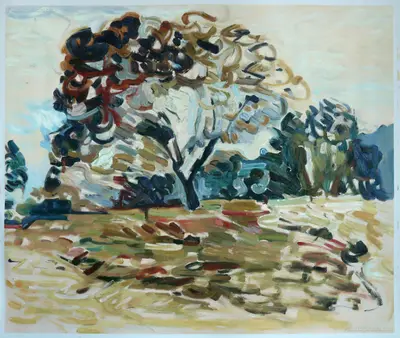
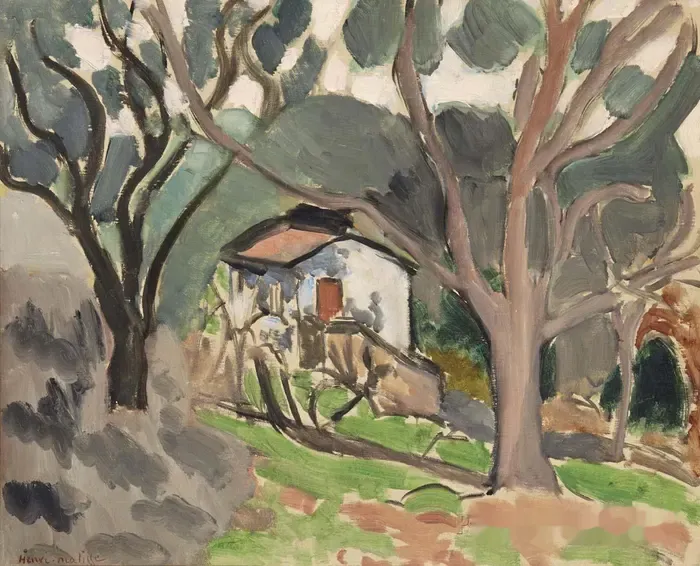
The Little House - Henri Matisse - Oil Painting is part of our hand painted oil painting collection from the Henri Matisse Paintings selection. Each canvas is worked by a trained artist, then inspected before dispatch — a practical route to owning fauvist wall decor at a fraction of gallery pricing.
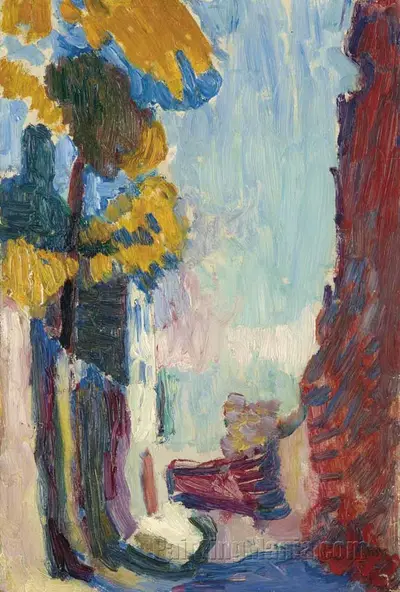
La maisonnette, 1919
Oil on canvas
The present painting was executed during the summer of 1919 in the woods of Meudon, not far from Henri Matisse's family home at Issy-Les-Moulineaux, to the south west of Paris. Matisse had established a pattern of spending the spring months in Nice and returning to Issy for the summer where he would explore the local surroundings. As he noted to his friend Charles Camoin, "I can travel around the neighborhood thanks to a small car I have purchased and that allows me to easily transport myself and my materials into the forest" (quoted in S. D'Alessandro et J. Elderfield, Matisse, Radical invention, 1913-1917, Chicago, 2010, p. 316). Against the backdrop of the last years of the Great War, Matisse also appeared to find solace through the execution of small-scale landscapes: the fact that he could complete them within a day, and often en plein air, provided him with an achievable task and a chance to find solitude within an intimate natural setting unspoiled by the ravages of the war. Matisse's reinvigorated interest in Landscape was also an expression of his renewed interest in the work of the Impressionists. Following the heady days of Fauvism and the exploration into abstraction which followed, Matisse had begun to feel caught between his instinct to explore new frontiers and the accompanying doubts this raised as to where he would end up.
As he sought to take stock of his position Matisse entered into several relationships with artists of the proceeding generation in an effort to gauge their opinion. From November 1916 he began to correspond with Claude Monet ; 1917 saw the start of a 30-year correspondence with Pierre Bonnard ; and throughout the spring of 1919 he began regular visits to Pierre-Auguste Renoir at his villa 'Les Collettes' at Cagnes-sur-Mer. Through these various exchanges would grow an important aspect of Matisse's subsequent artistic persona: his willingness to absorb and utilise the lessons learned by his artistic predecessors.
La maisonnette (or La cabanne as it has also been known) is an unambiguous demonstration of this quality. Though his discussions with Renoir, Matisse had renewed his admiration for the great founders of late 19th century French painting: Ingres, Courbet and particularly Manet. Several works from the period around 1919 clearly show Manet's influence on Matisse's palette which began to take on colours which had previously been mostly absent : the introduction of blacks and ochres, as well as a more faded and thinned-out selection of complementary greens and light purples. The present work is very much in the Manet style, with a pallet also clearly adapted to the subject. In La maisonnette we also witness Matisse's debt to Gauguin with the use of strong silhouettes for the trees and heavy but broken contours for the trees and the house. The dappled surfaces of the foreground and the foliage against the sky lend the canvas a Cézannian air, but according to Matisse's own writing are also due to his admiration for Corot whom he saw as the greatest of the 19th Century landscape painters. Matisse referred to his landscape works from this period as less significant than his more considered studio pictures. Whilst works such as La maisonnette no doubt served to provide the artist with respite from his troubles, they also served as a testing ground where he worked out important elements of the style he would go on to develop over the next thirty years.
As dining room wall art, the piece pairs naturally with other fauvist wall art and with warm neutrals, timber, and soft natural light.
Expect subtle, hand-made variation rather than factory uniformity. Each fine art canvas is painted with oils, allowed to cure properly, and inspected before it is approved for shipment.
Wondering where fine art oil painting looks best? Try a dining room mantel, a dining room sideboard, or a hallway gallery wall. The fine art subject reads clearly from a distance and rewards close viewing up near.
In short: The Little House - Henri Matisse - Oil Painting combines a fauvist composition, a 100% hand painted oil painting process, and the flexibility of made-to-order canvas sizes — a dependable choice for fine art oil painting and dining room wall art.
| Size | Price |
|---|---|
| 20 X 24 in | $47.98 |
| 24 X 36 in | $77.98 |
| 30 X 40 in | $104.48 |
| 36 X 48 in | $149.48 |
| 48 X 72 in | $291.98 |
The sizes shown are the reproduction canvas sizes we paint to order. The dimensions given in a work's description refer to the original artwork and will differ from the sizes offered here. Not sure? Read the size guide or e-mail us.
Free on orders over $60; a flat $5 below that. Dispatched in 1–2 business days; 30 days to send it back. Full policy.
Every canvas is painted by hand in oils on artist-grade stretched canvas, with an extra blank border left for framing. How to care for your painting.
Measurements are on the size guide, or e-mail [email protected] and we reply within one business day.