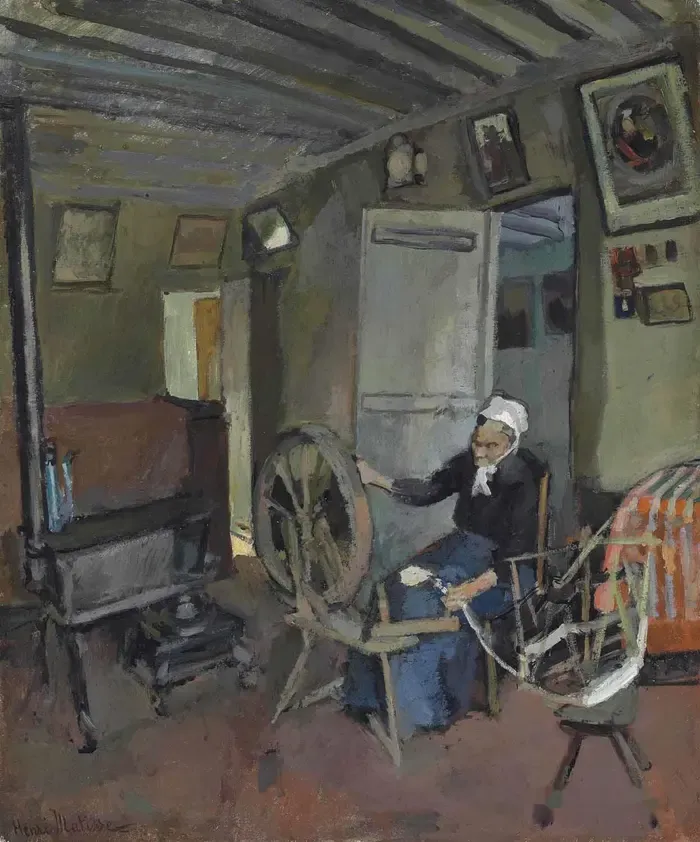
The Mother Massed in Her Home in Bohain by Henri Matisse
You save $58.47
Free shipping over $60 · 30-day returns · Dispatched in 1–2 business days
- Category
- Henri Matisse Paintings
- Color
- —
- Shipping
- Dispatched in 1–2 business days
- SKU
- PM59503-2
The Mother Massed in Her Home in Bohain - Henri Matisse - Oil Painting
About This Piece
From the first sketch to the final varnish, The Mother Massed in Her Home in Bohain is made by hand. Based on Henri Matisse's original. This fauvist oil painting wall decor is crafted on artist-grade canvas for anyone who wants portrait oil painting with the character of an original.
About the Artwork
La devideuse picarde (La mère massé dans son intérieur à Bohain), circa 1903
Oil on canvas
Private collection.
La Devideuse picarde (La mère Massé dans son intérieur à Bohain) was likely painted in 1903, during what various art historians - beginning with Alfred H. Barr, Jr. in 1951 – have labelled Henri Matisse’s “dark period” (A. H. Barr, Matisse: His Art and his Public, New York, 1951, p. 49). Barr was primarily referring to the conservatively sombre tonalities that Matisse adopted in his paintings during this period in an effort to make them more attractive to buyers and the Salon jurors. However, with the 1998 publication of Hilary Spurling’s The Unknown Matisse (op. cit.), we now have a more thorough understanding of the difficulties Matisse faced in these years, when darkness penetrated the artist’s life as well as his canvases, and how he overcame them through an unyielding commitment to his art.
By 1903, Matisse had faced an almost ruinous string of adversities. Since 1900, Matisse’s material burdens increased, with three children to support, few sales of his paintings, and his father’s refusal to further support him, partly through disapproval of his artistic choices. In May 1902 the Humbert scandal broke – Frédéric and Thérèse Humbert had for years leveraged their extensive business dealings against a non-existent inheritance, ruining eleven thousand investors who had lost their life savings. Armand and Catherine Parayre, the parents of Matisse’s wife Amélie, both worked for the Humberts and were implicated in the scandal. Their home, Amelie’s shop and Matisse’s studio were searched by police, and Armand Parayre would be arrested and imprisoned for over a month. Amélie’s health suffered and she was forced to close her millinery business, from which the artist’s family derived necessary income. Matisse was forced to take the role of sole breadwinner, family spokesman and defender. In early 1903, in order to take refuge from unrelenting public scorn, and to lighten the burden of stress and financial hardship that had overwhelmed his family, Matisse closed his Paris studio at 19, quai de Saint-Michel and took Amélie and their three children to live with his parents in Bohain-en-Vermandois. There was little escape from their problems, however, as Northern creditors had lost more than any other group of investors, and feelings in the region against the Humberts ran higher than anywhere else in France. More than once during this time, Matisse wrote of his desire to give up painting altogether; had he been a man of lesser will and character, this could have been the end of Matisse’s career as an artist.
Later that spring Matisse moved to a house in Bohain away from his parents, who increasingly disapproved of his choice of career and criticised his inability to properly support his family. Here he made his studio, which, as he finally resumed painting, he depicted in one of his best-known works of this period, L'atelier sous les toits now in the collection of the Fitzwilliam Museum, University of Cambridge. Scholars often point to the nightmarish overtones in its confined, claustrophobic space, and Pierre Schneider sees it as a reflection of the artist’s sense of imprisonment (Schneider op. cit. p. 192). We see this confined spatial perspective and sombre palette repeated in La Devideuse picarde. The sitter was identified as la Mere Massé, or Octavie Massé in a note by Auguste Matisse, the artist’s brother and first owner of the painting (Archives Matisse, Paris). She lived on the Rue Peu d’Aise opposite Matisse’s father’s seed store when the artist was a boy, and the families were well acquainted – Matisse also painted the sitter’s grandson and made two paintings of her daughter. Painting the woman at her spinning wheel, wearing the regional white cap, the cluttered interior shows the makeshift workroom typical to the homes of the working class of Bohain. An attempt at a traditional Flemish genre scene, the work is testament to Matisse’s desire to steer his art back on a traditional course, ‘so that a good purge will clear away the vegetation, weeds or otherwise, that is foreign to my nature and that I will have picked up along the way; and then I will be able to present a calm and smiling face to the crowd of art-lovers who do not care for anxious and tormented artists.’ (Matisse, letter to Simon Bussy, 31 July 1903, quoted in Schneider op. cit., p. 190). The present lot is one of two works Matisse presented at the first Salon d’Automne in October 1903, and would then be exhibited in the gallery of Ambroise Vollard, one of the most important dealers in French contemporary art at the turn of the twentieth century, crucial to the exposure of artists like Paul Cézanne, Pablo Picasso and Paul Gauguin. La Devideuse picarde offers a glimpse at the lesser-known Matisse; one year later the artist would escape to the South and resume experimentation in his work, leading to his radical breakthrough in 1905 which would result in his revolutionary Fauve canvases.
Every hand painted oil painting in this figurative series is finished on artist-grade canvas and checked against the original before it leaves the studio.
Materials & Craftsmanship
From primer to varnish, the work is done manually on artist-grade canvas. The absence of digital printing is deliberate: it keeps the figurative brushwork visible and gives the fauvist oil painting wall decor a museum-like finish.
What Is Included
- 100% hand-painted oil painting on artist-grade canvas — never a print or digital reproduction.
- A generous 2-inch blank canvas border surrounds the image to simplify mounting.
- Direct-from-studio worldwide delivery with no third-party resellers.
- Available canvas sizes for this hand painted oil painting: 20 X 24 in, 24 X 36 in, 30 X 40 in, 36 X 48 in, 48 X 72 in.
- Custom sizes available: order this painting in your preferred dimensions.
- Affordable delivery options via DHL, UPS, FedEx, USPS and more.
- Free canvas stretching on wooden stretcher bars; custom framing available on request.
- Before dispatch we email a digital proof so you can approve the finished canvas.
Styling & Placement
As entryway wall decor, this canvas brings color and texture without visual noise. It scales well from a small study to a large entryway feature wall, and it is a reliable choice when shopping for portrait oil painting as a gift.
Shipping & Guarantee
Whether the search term is portrait oil painting, entryway wall decor, or fauvist oil painting wall decor, this hand painted canvas delivers the same thing: a real painted surface, made to your chosen dimensions.
Sizes & prices
| Size | Price |
|---|---|
| 20 X 24 in | $58.48 |
| 24 X 36 in | $91.98 |
| 30 X 40 in | $123.48 |
| 36 X 48 in | $176.98 |
| 48 X 72 in | $329.48 |
The sizes shown are the reproduction canvas sizes we paint to order. The dimensions given in a work's description refer to the original artwork and will differ from the sizes offered here. Not sure? Read the size guide or e-mail us.
Shipping & returns
Free on orders over $60; a flat $5 below that. Dispatched in 1–2 business days; 30 days to send it back. Full policy.
Materials & craftsmanship
Every canvas is painted by hand in oils on artist-grade stretched canvas, with an extra blank border left for framing. How to care for your painting.
Sizing help
Measurements are on the size guide, or e-mail [email protected] and we reply within one business day.