Free shipping on orders over $60$5 flat rate under $604 items: 10% off · 8 items: 20% off
You save $58.47
Free shipping over $60 · 30-day returns · Dispatched in 1–2 business days
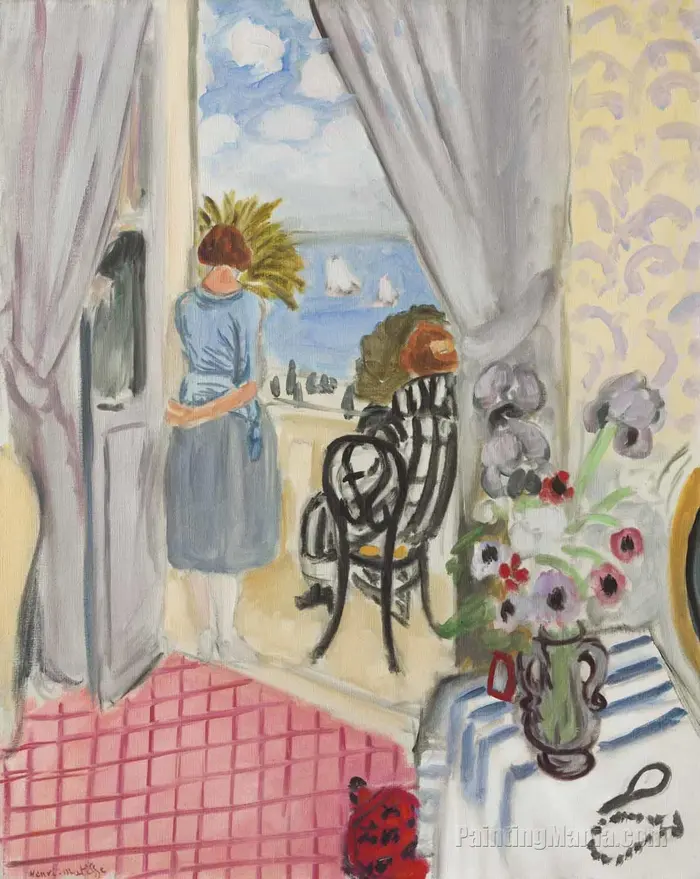
Nothing softens a bedroom like a painted surface. The Nice Regattas by Henri Matisse arrives as a hand painted oil painting on canvas, offering the fine art detail, soft gradients, and tactile finish that fine art oil painting shoppers look for.
Les régates de Nice
Painted in Nice, 1921
Oil on canvas
31 7/8 x 25 5/8 in. (81 x 65.1 cm.)
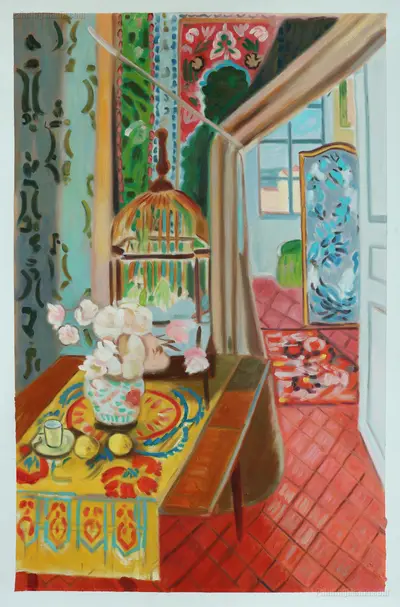
Matisse viewed the interior in Les régates de Nice as if from a ladder-like height, resulting in a plunging perspective that flattens the deep space, which extends from the interior foreground to the far marine horizon. Throughout this vast distance, Matisse employs cinematic deep focus: every pictorial element in Les régates de Nice, regardless of placement, is accorded the same degree of clarity. Matisse appreciated the French cinematic practice of using natural light to create fullness of form, unlike the preference in German film-making for single-source lighting, which generates strong, black and white, chiaroscuro contrasts. Devoid of color, early black-and-white cinema emphasized the role of light as a means of pictorial construction and expression. “Cinema was there to provide Matisse with a liberating model for ‘looking’ and ‘selecting,’ for such a humble and transformational dialogue with the natural world. It also provided a hallucinatory model for the release of hitherto unexpressed dreams and desires” (ibid., p. 118).
“From 1904 to 1916 Matisse elaborated an architectonics of color, whereas from 1917 to 1930 he moves to an architectonics of light,” Dominique Fourcade stated. “His new chromatic approach will consist of scattering a myriad of diverse colors on the canvas (it should be noted that only a colorist of the caliber of Matisse could produce these colors, let alone put them together on the same surface). In this first period in Nice, Matisse is still the greatest colorist of his time. The multitude of colored elements is held together and forms a coherent fabric through the grace of a unity of light. A kind of supreme plane of light pervades and unifies the otherwise implausible diversity of colors (diametrically opposed to the spectrum of realism or naturalism). This unique luminous plane, an architecture without pillars, is so strong that it achieves the annihilation of the third dimension of space—the depth of perspective that Matisse will nevertheless reinstate.
“This allover light is extremely difficult to achieve... He must paint this fragmented color and totalizing light in one and the same gesture, searching for the point of balance in a dramatic all or nothing effort... This pursuit of light is, at least until 1925, his most serious pursuit.
“In the end, all of Matisse’s research during these first years in Nice arrives at a new unity of surface: human beings and objects are not treated differently than floors or walls on the painting’s surface. Matisse progressively abolishes all pictorial distinction between the apparent subject of his paintings and the background of these same paintings. He resolves this subject-background distinction in terms of space, and resolves the problem of space in terms of light. Each parcel of the painting’s surface is a site of color...and each site of color becomes a source of light that, combined with all the other sources of light on the canvas, create a wholeness of light and space” (exh, cat., op, cit., 1987, pp. 52 and 55).
The poet and playwright Charles Vildrac visited Matisse around the time the artist painted Les régates de nices. “I knew most of the paintings that he had painted there these last years,” he recounted. “Without a doubt, I found myself in the room ‘of the Matisse paintings’... This room wasn’t as big as I thought... Besides, I had to realize that the painter had given it a fresh and entirely submissive soul...a soul which in reality it did not have: it was certainly a pleasant hotel room, but with the soul of a hotel room... Didn’t Matisse paint this window, these curtains saturated with light, this red rug, this furniture, the same day as when some magician had created this room with the stroke of a wand, while each object...offered up its grace to the light? You understand, the magician had been Matisse himself” (quoted in exh. cat., op. cit., 1986, p. 26).
Every hand painted oil painting in this fine art series is finished on artist-grade canvas and checked against the original before it leaves the studio.
Each canvas is painted entirely by hand with professional oil paints on artist-grade cotton canvas. No printing, giclée, or digital imaging is used at any stage, so the surface keeps the slight relief and color variation of real brushwork.
This fine art oil painting wall decor is equally at home in a residence, a boutique hotel, or a professional office. Its fauvist character makes it a safe, distinctive gift for anyone furnishing a bedroom.
In short: The Nice Regattas - Henri Matisse - Canvas Oil Painting combines a fauvist composition, a 100% hand painted oil painting process, and the flexibility of made-to-order canvas sizes — a dependable choice for fine art oil painting and bedroom wall art.
| Size | Price |
|---|---|
| 20 X 24 in | $58.48 |
| 24 X 36 in | $91.98 |
| 30 X 40 in | $123.48 |
| 36 X 48 in | $176.98 |
| 48 X 72 in | $329.48 |
The sizes shown are the reproduction canvas sizes we paint to order. The dimensions given in a work's description refer to the original artwork and will differ from the sizes offered here. Not sure? Read the size guide or e-mail us.
Free on orders over $60; a flat $5 below that. Dispatched in 1–2 business days; 30 days to send it back. Full policy.
Every canvas is painted by hand in oils on artist-grade stretched canvas, with an extra blank border left for framing. How to care for your painting.
Measurements are on the size guide, or e-mail [email protected] and we reply within one business day.