Free shipping on orders over $60$5 flat rate under $604 items: 10% off · 8 items: 20% off
You save $42.97
Free shipping over $60 · 30-day returns · Dispatched in 1–2 business days
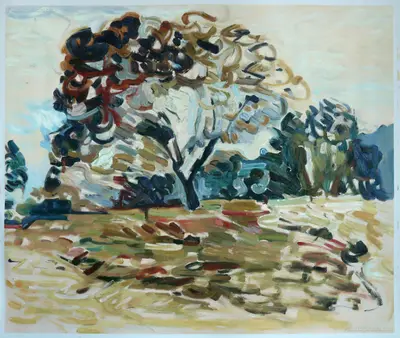
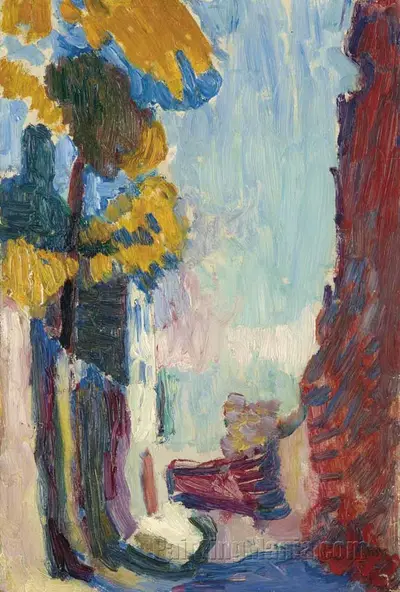
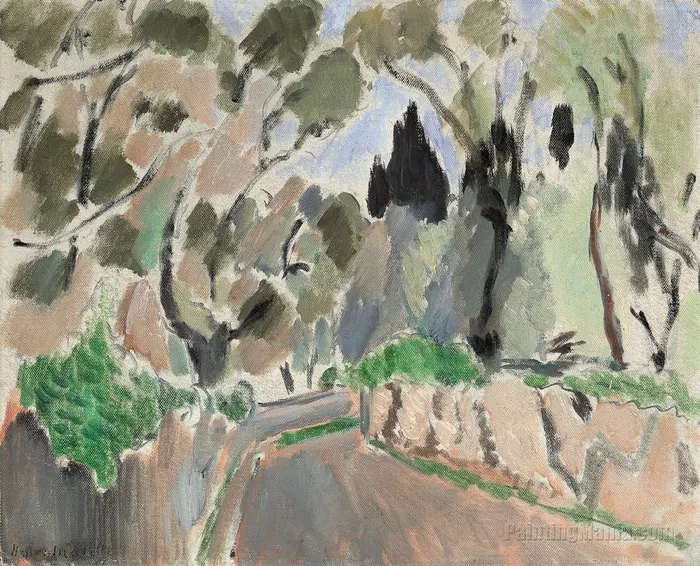
The Road (La route) by Henri Matisse is one of those images that never dates. Our studio recreates it as a hand painted oil painting — textured, color-rich, and ready to hang as canvas wall art in a bedroom, study, or reception area.
1918
Oil on canvasboard
Private collection, Switzerland.
‘I worked in the Impressionist manner, directly from nature, and later I strove for concentration, for a more intense expression with line as well as colour. So I was, of course, obliged in part to sacrifice other values, materials, spatial depth, and richness of detail. Now I want to bring all of this together…’ –Henri Matisse (quoted in P. Schneider, Matisse, London, 1984, p. 507).
Painted in 1918, Henri Matisse’s La route exemplifies the unique qualities of the artist’s early Nice period. His works from this period skillfully and seamlessly unite his virtuosity of the reduction of form with the immediacy of sensation that was part of the Impressionist legacy. Matisse’s relocation to Nice in 1917 was universally regarded as a watershed moment in his career, as it offered him a much-needed respite from his life in Paris and the demands imposed by the art world there. The change of pace and scenery offered the artist the opportunity to reflect on his intense artistic efforts over the past few years, and inspired him to pursue a new course. The experience of bright light and the ways to convey it were of keen interest to Matisse at critical stages of his career. The distinctive light in Nice was the thing that impressed Matisse most. Over and over, he would speak of it, “[as] soft and tender despite its brilliance’ (quoted in D. Aagesen, Matisse: In Search of True Painting, New York, 2012, p. 110).
With the recent purchase of an automobile in 1917, Matisse was easily able to explore the surrounding landscape and travel with his easel, paints and brushes to the nearby forests to paint en plein air. The new-found ease of access facilitated a return to the subject matter of landscapes, which became a source of both inspiration and solace for Matisse during and immediately after the war years. In the shadow of the Great War, Matisse seemed to find a certain peace in the creation of small-format landscapes: being able to complete them in one day, and often en plein air, set an accessible objective and grants him a chance for solitude in an intimate natural environment, unscathed from the ravages of war.
Matisse's return to landscape can also be explained by his renewed interest in the work of the Impressionists. After his radical exploration of Fauvism and Abstraction, Matisse arrived at a stage where he reconsidered using the naturalistic ideology of Impressionism when depicting light – a 'new' horizon that he was keen to explore yet dubious about the results. To guide his reflection, he came into contact with several artists of the previous generation, eager to hear their advice. In 1918, he paid several visits to Pierre-Auguste Renoir at his villa Les Collettes, in Cagnes-sur-Mer and brought his recent paintings with him. These visits to Renoir helped Matisse establish a link to the 19th-century French tradition at a time when he was ready to respond to its influence. He later realised that he and his contemporaries were not required to choose between abstract and realist modes of representation, they could have both.
In addition to painting en plein air, Matisse embraced other aspects of Impressionism during this period, such as a more muted, naturalistic colour palette and imagery over the vibrant palettes and radical compositions of his earlier Fauvist period. This shift is clearly recognisable in La route, where flat surfaces are juxtaposed against the overall depth of the composition. Though the present work shows signs of external influences, it encapsulates the artist’s distinctive handling. The thick, expressive brushstrokes animating the patches of green grass, the unusual, unnaturally colours of the trees, and the dark, hazy outlines. All of these elements embrace visual sensation over accuracy, evincing how Matisse filtered and revitalised aspects of Impressionism through his intuitive, emotive style.
As Pierre Schneider observed, ‘The difficulty was that a return to realistic representation was at once necessary and impossible. Unless—and this was the solution Matisse was looking for—the abstract image could be made to look like a realistic representation…Matisse was no longer satisfied with merely combining the two-and three-dimensional systems: he now wanted two-dimensional space to create effects which had so far been produced by three-dimensional space. It was no longer a question of skillfully combining realism with abstraction, but of getting abstraction to simulate realism’ (P. Schneider, Matisse, London, 1984, p. 507, p. 508).
Every hand painted oil painting in this fine art series is finished on artist-grade canvas and checked against the original before it leaves the studio.
From primer to varnish, the work is done manually on artist-grade canvas. The absence of digital printing is deliberate: it keeps the fine art brushwork visible and gives the fauvist oil painting wall decor a museum-like finish.
As bedroom wall art, this canvas brings color and texture without visual noise. It scales well from a small study to a large bedroom feature wall, and it is a reliable choice when shopping for fine art oil painting as a gift.
Browse our Henri Matisse Paintings selection for related fine art canvases, or commission this fine art image in a custom size. Every order is a hand painted oil painting, never a printed poster.
| Size | Price |
|---|---|
| 20 X 24 in | $42.98 |
| 24 X 36 in | $67.98 |
| 30 X 40 in | $91.48 |
| 36 X 48 in | $131.48 |
| 48 X 72 in | $249.48 |
The sizes shown are the reproduction canvas sizes we paint to order. The dimensions given in a work's description refer to the original artwork and will differ from the sizes offered here. Not sure? Read the size guide or e-mail us.
Free on orders over $60; a flat $5 below that. Dispatched in 1–2 business days; 30 days to send it back. Full policy.
Every canvas is painted by hand in oils on artist-grade stretched canvas, with an extra blank border left for framing. How to care for your painting.
Measurements are on the size guide, or e-mail [email protected] and we reply within one business day.