Free shipping on orders over $60$5 flat rate under $604 items: 10% off · 8 items: 20% off
You save $47.97
Free shipping over $60 · 30-day returns · Dispatched in 1–2 business days
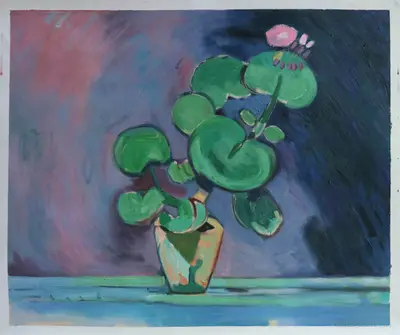
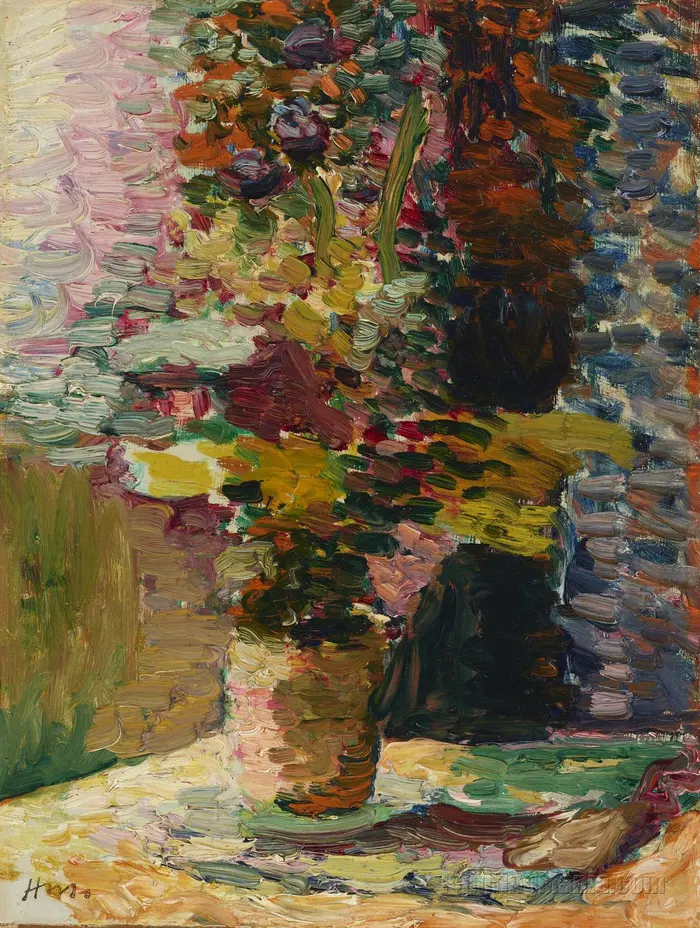
Vase of Flowers - Henri Matisse - Canvas Oil Painting suits both traditional and modern interiors. As a still life oil painting, it works as a standalone focal point or as part of a gallery wall gallery wall, and unlike a print it is genuinely hand painted in oils.
circa 1898-1900
Oil on card laid down on canvas
Previously in the Pierre Matisse collection and painted around 1898-1900, as Henri Matisse was rising to become a central figure of the Parisian avant-garde, Vase de fleurs presciently anticipates some of the most radical aspects of the artist’s oeuvre. A floral still life—one of Matisse’s greatest, perennial themes—is rendered with such a rich palette of vibrant color, applied with thick, lavish brushstrokes and with an unprecedented variety of colors and tones, that model the vase with flowers within the rich painterly surface. Together, these innovative formal characteristics marked the beginning of Matisse’s development towards the notorious Fauve canvases that were first exhibited four years later, in 1905. The year of 1898 marked a discernible shift within Matisse’s style beyond the influences of Impressionism, toward a style steeped in color and a freedom of brushwork. As John Elderfield described: “Once this commitment [to modernism] is made, Matisse’s art rapidly changes. During an extended stay in Corsica and Toulouse in 1898-99, he produced an important group of paintings in high-key arbitrary colors and with un-naturalistically broken or atomized forms… These ‘proto-Fauve’ paintings reveal the nature of Matisse’s genius as a colorist: his using color not to imitate light, but to create it (J. Elderfield, Henri Matisse, A Retrospective, exh. cat., The Museum of Modern Art, New York, 1992, p. 81).
After marrying in January 1898, Matisse and his new bride Amélie Parayre spent their honeymoon in London mainly to view J.M.W. Turner’s paintings on the suggestion of Camille Pissarro. In seeing Turner’s works in person, Matisse found a new appreciation of light and moved away from Impressionism. In Turner, Matisse saw not only light, but a means of creating an intense dreamlike sense of beauty rooted in but not slavishly representing nature. With this newfound discovery, Matisse traveled to Corsica and for the first time devoted himself fully to creating art. “Painting, even supposing it had been academic painting, could barely provide a living in those days. I was going to be forced to take up some other job,” explained Matisse. “I decided to give myself a year off, without impediments, in which I would paint as I wanted to. I no longer worked for anyone but myself. I was saved” (quoted in H. Spurling, The Unknown Matisse: A Life of Henri Matisse, 1869-1908, New York, 1998, vol. 1, p. 159). The works borne out of this period of seclusion with their highly keyed colors, tonal harmony and lack of modulation in the color planes all hint at Matisse’s later revolutionary flattening of the picture plane and firmly establish his unrivaled mastery of color above all else.
Throughout this pivotal period at the turn of the 20th century, Matisse painted a number of floral still-lives, such as the present Vase de fleurs, which to some extent is very abstract yet composed with a richly textured surface, very different from the highly figural yet more simplified in terms of form Bouquet, vase chinois, previously part of the Ann and Gordon Getty Collection (Christie’s, New York, 20 October 2022, lot 25; price realized: US $ 5,100,000). In the latter, bunches of chrysanthemums, ranunculi, or sunflowers—all relatively inexpensive flowers that were easy to come by at various points of the year—are easily recognizable. In the jewel-like impastos of Vase de fleurs painted in the two years preceding the Getty painting, it is virtually impossible to identify the flowers Matisse depicted here. There is no doubt that at the turn of the century, and as proved by Vase de fleurs, Matisse refined his artistic vision. As Jack Flam has described, ‘The still-lives of this period are notable for the dissonance of their colors, their vigorous brushstrokes, and their extensive use of a drawn contour. The impasto is usually quite thick, and pentimenti are often noticeable’ (Matisse, The Man and his Art, 1869-1918, London, 1986, p. 102-103).
It was above all Paul Cézanne who served as the artist’s great hero at this time. Indeed, Matisse had, in 1899, acquired the Cézanne’s Trois baigneuses (circa 1879-82, gift of Matisse to the Musée de la ville de Paris), which became a kind of talisman for the artist over the years that followed. Looking to the master of Aix’s majestically composed and masterfully colored still-lives, Matisse honed in on the compositional structure of his works, and the process of painting itself. ‘If Cézanne is right, then I am right,’ he once claimed. ‘And I knew that Cézanne had made no mistake’ (quoted in op. cit., 1998, p. 250).
Although the first ever exhibition dedicated to Van Gogh only took place in March 1901 at the Bernheim-Jeune gallery after Vase de fleurs was completed, there is no doubt that Matisse was influenced by some aspects of the Dutch master’s unique style. In contrast to the refinement and meticulousness of Cézanne’s art, the vigorous facture, rich impasto and vibrant colors of Vase de fleurs tells of the simultaneous influence of Van Gogh’s revolutionary painting, in particular his dazzling floral still-lives. These aesthetic characteristics would continue to develop in Matisse’s work for the following years, leading up to the canvases that instigated the great furor when they were shown at the Salon d’Automne in 1905.
The still life subject is rebuilt stroke by stroke in oil, giving the finished canvas the depth expected of fauvist oil painting wall decor.
Trained artists work in stages — underpainting, mid-tones, highlights, and detail — using traditional oils on canvas. Because nothing is printed, every hand painted oil painting has its own subtle texture and depth.
For gallery wall art that does not feel generic, a painted still life canvas is hard to beat. It is a popular still life oil painting pick for new homeowners and a durable alternative to seasonal poster art.
In short: Vase of Flowers - Henri Matisse - Canvas Oil Painting combines a fauvist composition, a 100% hand painted oil painting process, and the flexibility of made-to-order canvas sizes — a dependable choice for still life oil painting and gallery wall art.
| Size | Price |
|---|---|
| 20 X 24 in | $47.98 |
| 24 X 36 in | $77.98 |
| 30 X 40 in | $104.48 |
| 36 X 48 in | $149.48 |
| 48 X 72 in | $291.98 |
The sizes shown are the reproduction canvas sizes we paint to order. The dimensions given in a work's description refer to the original artwork and will differ from the sizes offered here. Not sure? Read the size guide or e-mail us.
Free on orders over $60; a flat $5 below that. Dispatched in 1–2 business days; 30 days to send it back. Full policy.
Every canvas is painted by hand in oils on artist-grade stretched canvas, with an extra blank border left for framing. How to care for your painting.
Measurements are on the size guide, or e-mail [email protected] and we reply within one business day.