Free shipping on orders over $60$5 flat rate under $604 items: 10% off · 8 items: 20% off
You save $58.47
Free shipping over $60 · 30-day returns · Dispatched in 1–2 business days
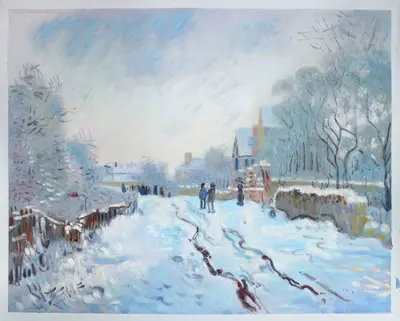
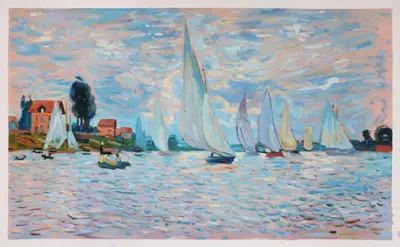
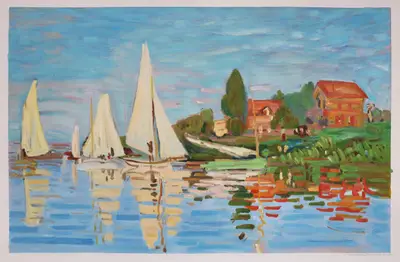
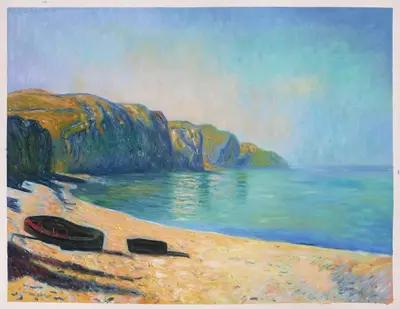
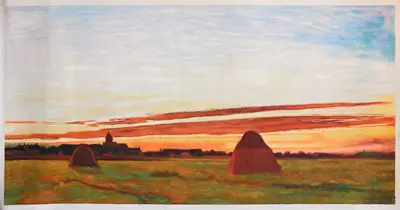
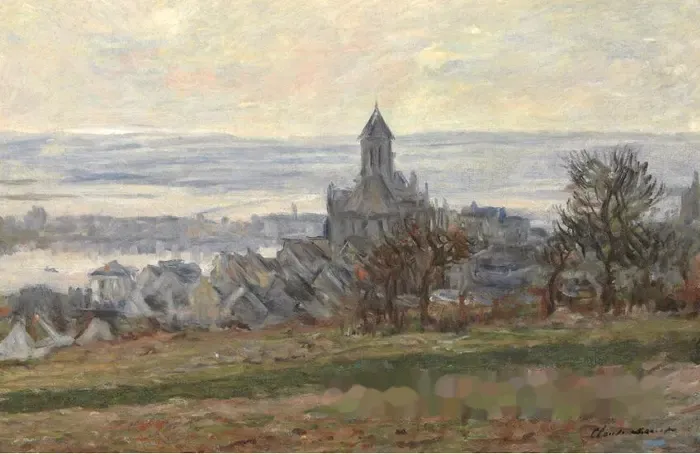
Looking for fine art oil painting with real brushwork? L'eglise de Vetheuil - Christie's is reproduced by hand in oils on artist-grade canvas after Claude Monet. The result is a piece of impressionist oil painting wall decor that anchors a bedroom and rewards a closer look.
L'église de Vétheuil - Christie's
1881
Oil on canvas
Paris, Musée de l'Orangerie, Centenaire Monet-Rodin, December 1940-March 1941, no. 28.
In 1878, beset with financial difficulties, Monet decided to move from Argenteuil further down the Seine valley to Vétheuil, a medieval town located on the Seine about 28 miles northwest of Paris. He and his family, along with his patrons Alice and Ernest Hoschedé and their family, shared a house on the river, and Monet would often take a boat out to paint. Monet tirelessly explored this area for the three years he lived there, depicting scenes in all seasons. His works of these years, while less well known than those of the early 1870s or his later series, were pivotal to Monet's life and career.
Monet was at this point the acknowledged leader of the Impressionists and had been hailed by critics such as Emile Zola and Georges Rivière. It was Monet's Impression, soleil levant, 1873 (Wildenstein, no. 263; Musée Marmottan-Monet, Paris), shown at the first Impressionist exhibition, that provided a name for the group; the critic Louis Leroy famously wrote that this "impression" was less finished than half-manufactured wallpaper. In the late 1860s and early 1870s, Monet had painted contemporary scenes of yachting, promenading, and residential gardens at Argenteuil and Paris. Immediately prior to his move to Vétheuil, he painted numerous scenes in Paris--the Gare Saint-Lazare, the Parc Monceau, and the Rue Saint-Denis and Rue Montorgueil--but these paintings were the last in which he would depict life in the French capital. Instead, he began to concentrate more and more on landscape. Carole McNamara wrote, "Even among his landscape paintings there was a subtle change in emphasis. No longer did they show suburban promenades as they did at Argenteuil; the landscapes become more rural, with the human aspect reduced and occasionally totally removed as Monet looked back to the earlier Barbizon painting in which the viewer is alone in the rural landscape" (in C. Stuckey et al., Monet at Vétheuil: The Turning Point, exh. cat., University of Michigan Museum of Art, Ann Arbor, 1998, p. 67).
"The years that Monet spent at Vétheuil represent a watershed in his career--a decisive moment of personal and artistic reassessment and the most momentous change in the career of the most revolutionary Impressionist" (ibid., pp. 13 and 41). Following his move to Vétheuil, Monet entirely abandoned the contemporary themes that had dominated his earlier oeuvre and began to focus instead on the depiction of fugitive aspects of nature, employing a nascent serial technique that laid the groundwork for his most important later production. With their sensitive description of the changing effects of light on water, the views of the Seine at Vétheuil indeed presage the last great series of Monet's career: the waterlilies at Giverny.
At the time that Monet moved to Vétheuil, it was an idyllic, agrarian hamlet of just a few hundred inhabitants. The town was splendidly situated on a hill overlooking a gentle bend in the Seine. Its major landmark was the 12th century church of Notre-Dame, which occupied a commanding position in the heart of the village. With neither bridges nor rail station and only minimal industry, Vétheuil showed little evidence of modernity, which was making major inroads at the time elsewhere in the vicinity of Paris. Shortly after settling at Vétheuil in 1878, the artist described the town in a letter to Eugène Maurer as a "...ravishing spot from which I should be able to extract some things that aren't bad" (quoted in M. Clarke and R. Thomson, Monet: The Seine and the Sea, exh. cat., The Royal Scottish Academy, Edinburgh, 2003, p. 17).
Every hand painted oil painting in this fine art series is finished on artist-grade canvas and checked against the original before it leaves the studio.
Expect subtle, hand-made variation rather than factory uniformity. Each fine art canvas is painted with oils, allowed to cure properly, and inspected before it is approved for shipment.
Wondering where fine art oil painting looks best? Try a bedroom mantel, a dining room sideboard, or a hallway gallery wall. The fine art subject reads clearly from a distance and rewards close viewing up near.
| Size | Price |
|---|---|
| 20 X 24 in | $58.48 |
| 24 X 36 in | $91.98 |
| 30 X 40 in | $123.48 |
| 36 X 48 in | $176.98 |
| 48 X 72 in | $329.48 |
The sizes shown are the reproduction canvas sizes we paint to order. The dimensions given in a work's description refer to the original artwork and will differ from the sizes offered here. Not sure? Read the size guide or e-mail us.
Free on orders over $60; a flat $5 below that. Dispatched in 1–2 business days; 30 days to send it back. Full policy.
Every canvas is painted by hand in oils on artist-grade stretched canvas, with an extra blank border left for framing. How to care for your painting.
Measurements are on the size guide, or e-mail [email protected] and we reply within one business day.