Free shipping on orders over $60$5 flat rate under $604 items: 10% off · 8 items: 20% off
You save $234.97
Free shipping over $60 · 30-day returns · Dispatched in 1–2 business days
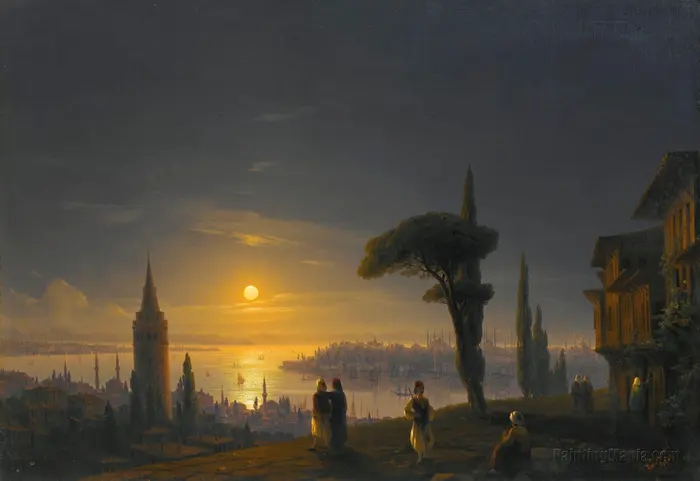
Upgrade your walls with The Galata Tower by Moonlight - Ivan Aivazovsky - Canvas Wall Art. Every fine art reproduction is painted entirely by hand, so the surface carries the depth and variation of an original oil painting rather than the flatness of a digital canvas print.
1845
Oil on canvas
The Galata Tower by Moonlight is among Aivazovsky's earliest views of Constantinople. Exceptionally detailed, beautifully balanced and lit with such sophistication that each distant tree, rooftop and sail adds another layer of depth to the canvas, it is an outstanding example of the high standards of which he was capable. It is likely that the offered lot is referenced by his biographer Nikolai Sobko, who notes that in 1845 Aivazovsky painted two views of Constantinople 'from the Golden Horn and from the Galata Tower side'. Both were presented to Emperor Nicholas I in November that year at the behest of the President of the Academy. After this Aivazovsky was commissioned by the Emperor to paint views of four Black Sea ports, Sevastopol', Odessa, Feodosia and Kerch (see N.P.Sobko, Dictionary of Russian Artists, St Petersburg, 1893, vol.I, p.300).
Aivazovsky visited Constantinople several times over the course of his life and famously returned to the subject almost every year in his work. The present canvas however, was painted from his very first impressions of the city when he visited as a young man in April 1845 at the end of a tour of Asia Minor, the Aegean, the Levant and Troy with Grand Duke Konstantin Nikolaevich. His next visit did not take place until 1857. Aivazovsky made dozens of sketches of the city at this time which he worked up into larger paintings in his Theodosia studio. A number of these early Constantinople views were exhibited in Theodosia in the spring of 1846 (fig.1, Coffee-house by the Ortak?y Mosque, Constantinople, 1846). Their brilliance was immediately apparent. As Valentin Serov's father wrote 'I never even knew that he paints human figures so well; there is so much life everywhere, so much brilliance, and now there are no longer the exaggerations people previously held against him.... All in all I can't image there is any artist in the whole of Europe who surpasses Aivazovsky in this type of painting' (cited in G.Caffiero, I.Samarine, Seas, Cities and Dreams, p.42).
The present view encompassing the Galata Tower, Golden Horn and Bosphorus is taken from one of the highest points in the city, the Turkish equivalent perhaps of Moscow seen from the Sparrow Hills. On the northern shore of the Golden Horn, the medieval Galata Tower, also known as The Tower of Christ (Christea Turris), is one of Constantinople's most striking landmarks. Built by the Genoese in 1348, it formed an important part of the northernmost fortifications of their colony of Galata. Aivazovsky travelled extensively in Italy in the early 1840s and Neapolitan lighthouses and Genoese towers feature in several of his canvases from this period, so it is unsurprising that this landmark resonated with Aivazovsky and became the central structure for some of his panoramic views of Constantinople.
Aivazovsky experimented with this panorama soon after his return from his first trip, in Constantinople; Galata and the Golden Horn, 1846 (fig.2). It is a magnificent work taken from a slightly higher viewpoint, yet the balance of the composition is uneasy, the colossal oak tree and bucolic scene in the foreground competing with the tower on the left and cityscape beyond. In the present work these tensions are resolved beautifully: the pine trees balance the tower without overpowering it; the figures populate the foreground without an air of theatricality, all but one with their backs to the viewer as though sharing in our admiration of the view. But it is arguably his dextrous use of moonlight which transforms this painting. The flashes of light on the domes and minarets of the Sultanahmet, Suleymaniye and Bayezit Mosques on the far peninsula mirror the white folds picked on the nearby onlookers' garments; the moonlight subtly divides the near shore into three distinct planes, while allowing the far shore to reflect in the channel between; the opaque sails to the left glint white while those moored at the nearby Pera shore are elegant and translucent.
What was it about the Ottoman capital which so captivated Aivazovsky and inspired some of his greatest works? The cultural and economic ties between Theodosia and Constantinople are often cited in explanation, the commercial possibilities and the large Armenian communities of both cities - all undeniably true. But in his best views of the city, Constantinople, Moonlit view from Eyüp, 1874 (fig.3) or Moonrise over the Golden Horn (lot 10 in the present sale), the tranquility, the warmth of light and the magnificence of the panorama speak for themselves. For an artist who had mastered the complex nuances of dawn and dusk light over its several hills and shorelines, Constantinople would always be an irresistible subject with endless possibilities, each new viewpoint an entirely fresh perspective.
The fine art subject is rebuilt stroke by stroke in oil, giving the finished canvas the depth expected of romantic oil painting wall decor.
We use a 100% hand-painted process: stretched artist-grade canvas, layered oil pigment, and a final protective varnish. There are no inkjet prints or mechanical reproductions in this collection — just a painted fine art artwork made to order.
Build a gallery wall gallery wall around this fine art oil painting, or let it stand alone as a single statement. The hand painted canvas finish keeps the fine art composition looking intentional in both classic and contemporary rooms.
Browse our Ivan Aivazovsky Paintings selection for related fine art canvases, or commission this fine art image in a custom size. Every order is a hand painted oil painting, never a printed poster.
| Size | Price |
|---|---|
| 30 X 40 in | $234.98 |
| 36 X 48 in | $318.48 |
| 48 X 72 in | $606.98 |
The sizes shown are the reproduction canvas sizes we paint to order. The dimensions given in a work's description refer to the original artwork and will differ from the sizes offered here. Not sure? Read the size guide or e-mail us.
Free on orders over $60; a flat $5 below that. Dispatched in 1–2 business days; 30 days to send it back. Full policy.
Every canvas is painted by hand in oils on artist-grade stretched canvas, with an extra blank border left for framing. How to care for your painting.
Measurements are on the size guide, or e-mail [email protected] and we reply within one business day.