Free shipping on orders over $60$5 flat rate under $604 items: 10% off · 8 items: 20% off
You save $49.97
Free shipping over $60 · 30-day returns · Dispatched in 1–2 business days
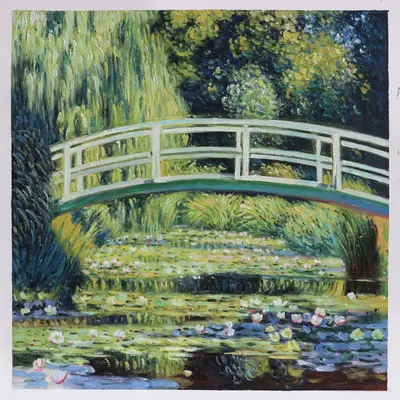
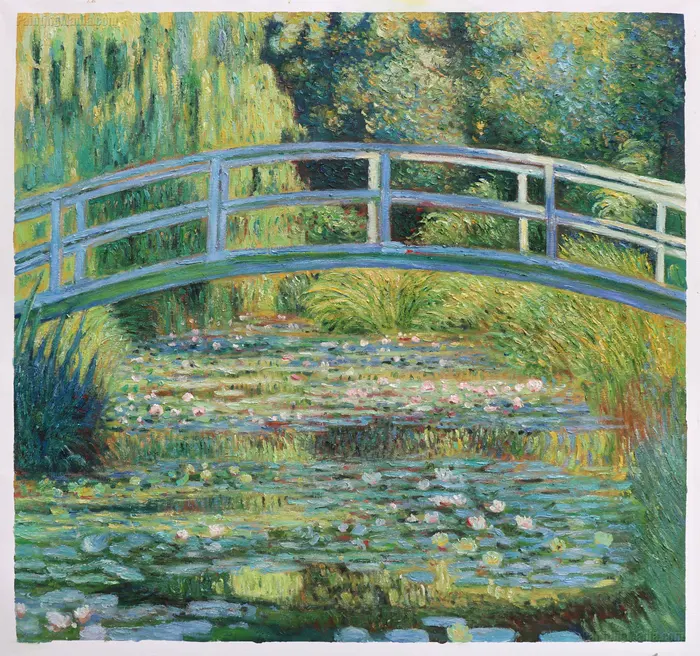
The Waterlily Pond with the Japanese Bridge - Claude Monet - Cityscape Oil Painting suits both traditional and modern interiors. As a cityscape oil painting, it works as a standalone focal point or as part of a home office gallery wall, and unlike a print it is genuinely hand painted in oils.
The Waterlily Pond with the Japanese Bridge
1899
Oil on canvas
34.6 x 36.6 inches
National Gallery London, United Kingdom.
By the 1890s, the financial worries that had plagued Monet for most of his life were coming to an era and he was able to buy Giverny - in fact he had established some wealth and was able to lavish his money on his own home and garden for the first time. It would result in a stunning and unique property, which included the most exciting garden - designed by the artist - and its Water Lily Pond. Planning permission was granted in 1893 and he spent much of his focus on the bridge in his works. Incredibly, he only painted about three works of the lily pond up to 1897, This work, from 1899, is exquisite in its composition of background trees, weeping willow, and the bridge, which underwent many alterations up to 1910. The pond here is literally obliterated by vegetation and lilies. It is composed of short brushstrokes - a familiar method during his mature years. In a letter, Monet described how he had planted the water lilies for fun - he had never intended painting them, however, once they established themselves they almost became his only source of inspiration. He wrote: "I saw, all of a sudden, that my pond had become enchanted... Since then, I have had no other model."
When Monet exhibited these paintings at Durand - Ruel's gallery in 1890, a number of critics mentioned his debt to Japanese art. More telling, the impenetrable green enclosure - heightened in the National Gallery painting by the placement of the top of the bridge's arch just below the painting's top edge - harkens back to the hortus conclusus (closed garden) of medieval images, while also evoking a dreamlike contemplative zone consonant with symbolist literature, especially poems such as "Le Nénuphar blanc" by Stéphane Mallarmé. Gustave Geffroy described this effect in his review of the exhibition (Le Journal, November 26, 1900), speaking of "this minuscule pool where some mysterious corollas blossom," and "a calm pool, immobile, rigid, and deep like a mirror, upon which white water lilies blossom forth, a pool surrounded by soft and hanging greenery which reflects itself in it."
Collectors often choose this cityscape image when searching for cityscape oil painting that feels substantial rather than decorative or disposable.
Expect subtle, hand-made variation rather than factory uniformity. Each cityscape canvas is painted with oils, allowed to cure properly, and inspected before it is approved for shipment.
Wondering where cityscape oil painting looks best? Try a home office mantel, a dining room sideboard, or a hallway gallery wall. The cityscape subject reads clearly from a distance and rewards close viewing up near.
| Size | Price |
|---|---|
| 20 X 20 in | $49.98 |
| 24 X 24 in | $62.48 |
| 30 X 30 in | $90.48 |
| 36 X 36 in | $142.48 |
| 40 X 40 in | $171.48 |
| 48 X 48 in | $215.98 |
The sizes shown are the reproduction canvas sizes we paint to order. The dimensions given in a work's description refer to the original artwork and will differ from the sizes offered here. Not sure? Read the size guide or e-mail us.
Free on orders over $60; a flat $5 below that. Dispatched in 1–2 business days; 30 days to send it back. Full policy.
Every canvas is painted by hand in oils on artist-grade stretched canvas, with an extra blank border left for framing. How to care for your painting.
Measurements are on the size guide, or e-mail [email protected] and we reply within one business day.